
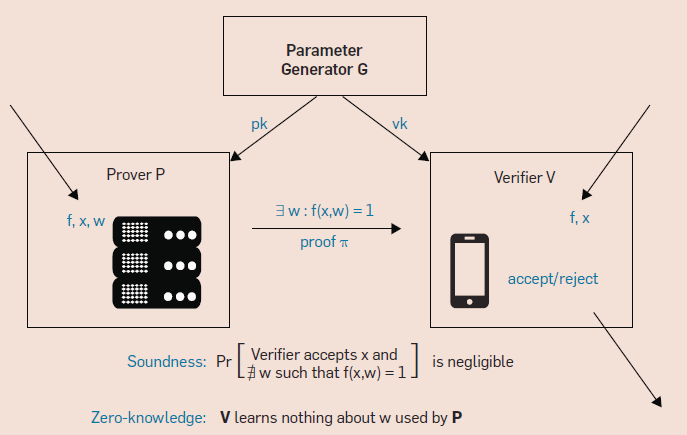

There are times when the highest levels of privacy and security are required to protect a piece of information, but there is still a need to prove the information’s existence and accuracy. For the Department of Defense (DoD), the proof could be the verification of a relevant capability. How can one verify this capability without revealing any sensitive details about it? In the commercial world, this struggle manifests itself across banking transactions, cybersecurity threat disclosure, and beyond. One approach to addressing this challenge in cryptography is with zero-knowledge proofs. A zero-knowledge proof is a method where one party can prove to another party that they know a certain fact without revealing any sensitive information needed to demonstrate that the fact is true.
The Defense Advanced Research Projects Agency (DARPA) in July 2019 detailed a program seeking research proposals for to help the Defense Department (DoD) understand zero-knowledge proofs. In cryptography, a zero-knowledge proof or zero-knowledge protocol is a method by which one party (the prover) can prove to another party (the verifier) that they know a value x, without conveying any information apart from the fact that they know the value x. The essence of zero-knowledge proofs is that it is trivial to prove that one possesses knowledge of certain information by simply revealing it; the challenge is to prove such possession without revealing the information itself or any additional information.
The Securing Information for Encrypted Verification and Evaluation (SIEVE) program aims to increase the efficiency and technology behind zero-knowledge proofs, or a method by which one party can prove to another that they know specific knowledge without revealing sensitive information. Zero Knowledge Protocol (or Zero Knowledge Password Proof, ZKP) is a way of doing authentication where no passwords are exchanged, which means they cannot be stolen. This is cool because it makes your communication so secure and protected that nobody else can find out what you’re communicating about or what files you are sharing with each other.
A protocol implementing zero-knowledge proofs of knowledge must necessarily require interactive input from the verifier. This interactive input is usually in the form of one or more challenges such that the responses from the prover will convince the verifier if and only if the statement is true, i.e., if the prover does possess the claimed knowledge. If this were not the case, the verifier could record the execution of the protocol and replay it to convince someone else that they possess the secret information. The new party’s acceptance is either justified since the replayer does possess the information (which implies that the protocol leaked information, and thus, is not proved in zero-knowledge), or the acceptance is spurious, i.e., was accepted from someone who does not actually possess the information.
“A zero-knowledge proof involves a statement of fact and the underlying proof of its accuracy,” said Dr. Josh Baron, program manager in DARPA’s Information Innovation Office (I2O). “The holder of the fact does not want to reveal the underlying information to convince its audience that the fact is accurate. Take, for example, a bank withdrawal. You may want a system that allows you to make a withdrawal without also having to share your bank balance. The system would need some way of verifying that there are sufficient funds to draw from without having to know the exact amount of money sitting within your account.”