

Energy is the fuel for growth and life. Despite centuries of over-reliance on fossil-based energy sources with devastating effects on the planet, more environmentally friendly and renewable options keep emerging as suitable alternatives.
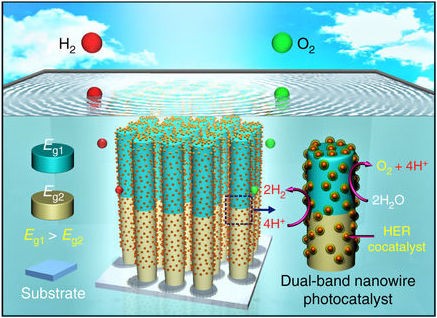
Hydrogen generation by water splitting has long attracted attention due to its zero-emission advantage. Each water molecule comprises an oxygen atom and two hydrogen atoms. The hydrogen atoms are extracted and then can be reunited to create highly flammable hydrogen gas or combined with CO2 to create hydrocarbon fuels, creating a plentiful and renewable energy source. The problem, however, is that water molecules do not simply break down when sunlight shines on them, they need a little help from a solar-powered catalyst.
The process uses a special kind of solar cell that absorbs sunlight and conveys electricity to a pool of carbon dioxide dissolved in water. Catalysts spur a chemical transformation that yields oxygen and a carbon-based byproduct. The technological challenge is to develop cheap, efficient catalysts and durable solar cells. “This will require a long-lasting, worldwide research effort, probably similar to fusion energy, which does, however, not guarantee success in due time,” he said. Countries would also need to find a way to pay for it.
Water splitting or electrolysis is a technique employed in decomposing water molecules into hydrogen and oxygen by the passage of an electric current. It requires excess energy to overcome the reaction’s activation barriers; hence, it requires catalysts to increase the efficiency of the chemical process.
The theoretical minimum voltage needed to split water molecules into hydrogen and oxygen is 1.23 V. However, in real world systems, 1.5 V or more is generally needed because of the low reaction kinetics. So far, other researchers have only been able to achieve this voltage level through the use of either inefficient materials, such as titanium oxide, or very expensive semiconductors, such as gallium arsenide. Also, overcoming the corrosive degradation of these “artificial photosynthesis” systems remains a monumental challenge and has thus far eluded commercialization.
To create practical solar fuels, scientists have been trying to develop low-cost and efficient materials, known as photoanodes, that are capable of splitting water using visible light as an energy source. Over the past four decades, researchers identified only 16 of these photoanode materials. Now, using a new high-throughput method of identifying new materials, a team of researchers led by Caltech’s John Gregoire and Berkeley Lab’s Jeffrey Neaton and Qimin Yan have found 12 promising new photoanodes.
An international team of researchers has now succeeded in raising the efficiency of producing hydrogen from direct solar water-splitting to a record 19 per cent. They did so by combining a tandem solar cell of III-V semiconductors with a catalyst of rhodium nanoparticles and a crystalline titanium dioxide coating.