
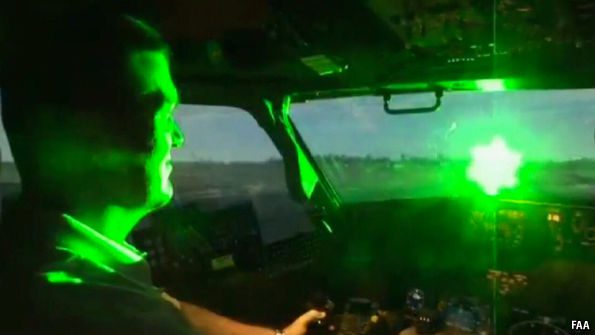

Laser attacks targeting pilots and air crews are a major concern across the world with most attacks reported to take place during take-off and landing. According to figures from the US Federal Aviation Authority, there were 6,753 laser illuminations reported in 2017. Until recently, the expense of lasers had limited their use to professional shows, but lower prices on handheld laser pointers have made this type of device widely available. They have also become easier to buy on the internet. However, these laser pointers have been cause of many aircraft accidents.
Lasers are a source of collimated, monochromatic, coherent light that can travel long distances with very little loss of intensity. This coherent property is what allows a laser to maintain a narrow, high-powered beam over long distances. This is also the cause of lasers being able to do damage to sensors, facilities, and personnel at a long range. Results of these attacks include distraction, obscuring of instruments and dials, a high probability for short-lived “flash” blindness and even permanent eye damage.
Of huge concern has been the use of military grade or ‘dazzler’ lasers, marking a serious change from the previous use of commercially available devices, and poses a far greater threat to military personnel. They have also become as tool to harass adversaries. The US accused China of pointing lasers at US military aircraft near Djibouti multiple times in the last few weeks, but Beijing has denied the allegations.
The US said there have been at least four such incidents near Djibouti, and in one of the most recent, two C-130 pilots became dizzy and saw “rings.” China opened its first overseas military base in Djibouti in 2017 and has raised concerns among American military officials about the proximity of the Chinese military installation to American forces. The Chinese have characterized the base as a logistics hub for peacekeeping and anti-piracy operations.
The imminent deployment of laser directed energy weapons on aircrafts, ships and vehicles is also causing concerns in militaries. The U.S. and German navies are developing laser cannon for their warships, Russia might mount a laser gun for its next-generation jet fighter, and the U.S. Army wants to deploy laser-armed Stryker armored vehicles by 2022. Defense Advanced Research Projects Agency (DARPA) is also concerned that US aircraft could be targeted and attacked by adversaries in the future as rapid improvements in high-energy laser weapons are happeneing.
Lasers are also increasingly being employed both by terrorists and security agencies. The military and security agencies are using Handheld Lasers as non lethal weapons to temporarily blind terrorists and at check points for crowd control. Lasers have been used en masse against riot police in demonstrations in regions as diverse as Canada, the U.S., Ireland, Thailand, Greece, Egypt, and Italy, among others. In Seattle, WA, protesters at a WTO summit directed pointers in the field of vision of crowd-control police. In Cairo in 2013, dozens of green lasers were seen striking Egyptian military helicopters circling over Tahrir Square during large-scale gatherings, as well as directed against governmental buildings, police, and, at times, opposing protestors.
Therefore research is increasingly looking for laser protection technologies. Last year, the aircraft manufacturer Airbus announced that it was joining with Lamda Guard, a Canadian company, to test a metamaterial-based coating for cockpit windows to protect pilots in commercial aircraft from being blinded by laser pointers.