
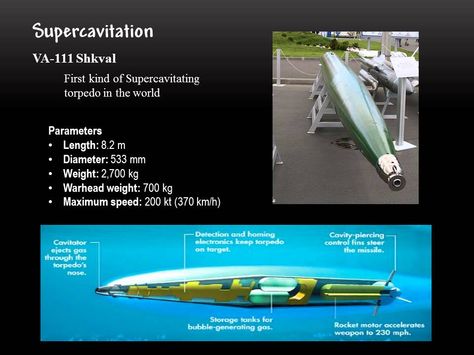

One of the biggest problems with trying to get torpedos to travel faster is the fact that water is a thousand more times dense than air, so in order to overcome that resistance researchers have had to try a variety of different techniques. One of the phenomenon called supercavitation uses cavitation effects to create a bubble of gas inside a liquid large enough to encompass an object travelling through the liquid, greatly reducing the skin friction drag on the object and enabling achievement of very high speeds. Supercavitating vehicle travelling faster than a passenger jet shall be capable of sailing from London to New York in just five hours. Supercavitation is also being applied to develop a range of weapons like underwater mine bullets, homing torpedoes, submarines and boats.
Many countries are involved in research in this area Russia, followed by Ukraine in Kiev Research Institute of Hydrodynamics, France within the framework of Action Concert?e Cavitation , Germany with its Superkavitierender Unterwasserlaufkörper (“supercavitating underwater running body”) and the USA.
One of the most innovative underwater weapons developed by the Soviet Union was the VA-111 Shkval (“Squall”) supercavitating torpedo. According to the authors of the journal, “Squall”, which is the first modern weapons using supercavitation is probably the largest breakthrough in submarine warfare since the invention of the submarine itself.
China and Iran were engaged in copying Russian technology, it is reported that China bought 40 torpedoes “Squall” in Kazakhstan. Iran claims to have a supercavitating torpedo of its own it calls Hoot, and which is assumed to be a reverse-engineered Shkval. On 7 May 2017, Iranian forces reportedly test fired a Hoot In 2015, China claimed to have solved critical challenges has brought supersonic submarines close to reality.
The Pentagon in conjunction with DARPA and the US Navy, have been designing and developing a Supercavitating underwater submarine. In 2006, DARPA first announced about the ‘Underwater Express program’ whose ultimate goal is a new class of underwater craft for littoral missions that can transport small groups of Navy personnel or specialized military cargo at speeds up to 100 knots for an hour at its most basic. The contracts under which were awarded to Northrop Grumman and General Dynamics Electric Boat. While supercaivitating entire submarines have proved to be daunting tasks , US has gone ahead with developing supercvitating bullets as well as Ghost vessel which use partial supercavitation.