
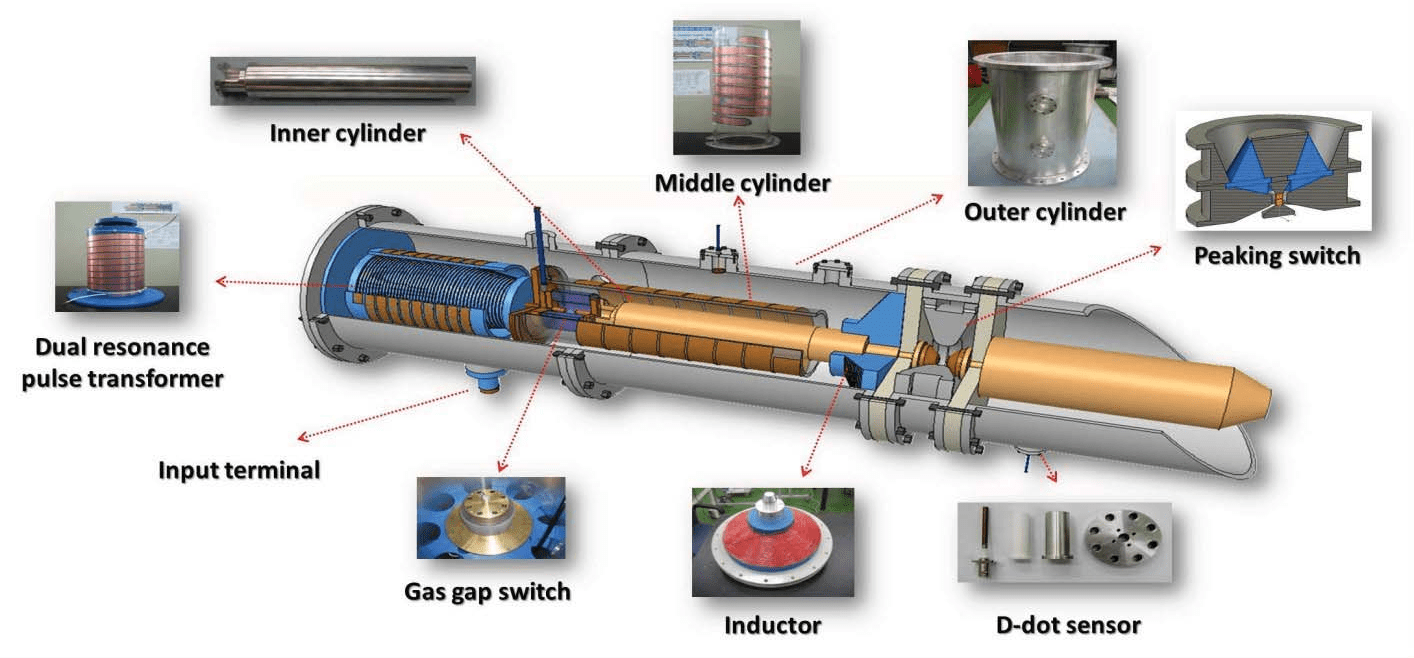

A high-powered microwave weapon (HPM) is type of Directed Energy Weapon (DEW) for employing radio frequency energy against a variety of targets. They are principally counterelectronic weapons and could be used to destroy any enemy electronic systems, including radars, computer systems and communications infrastructures. Electromagnetic weapons can destroy, intercept or jam approaching enemy missiles, drones, rockets or aircraft at much lesser cost than firing an interceptor missile which can cost up to hundreds of thousands of dollars.
HPM systems offer military commanders the options of: Speed-of-light, all weather attack of enemy electronic systems, Area coverage of multiple targets with minimal prior information on threats characteristics, Surgical strike (damage, disrupt, degrade) at selected levels of combat, Minimum collateral damage in politically sensitive environments, Simplified pointing and tracking and eep magazines (meaning long operating time without replenishment) and low operating costs.
HPM systems can be Narrowband or Ultra Wideband type, depending on the bandwidth of the transmitted waveform. Many systems, like those based on commercial radar systems are narrow band or have transmitted bandwidths of 1% or less. Narrow band systems can couple to systems very efficiently if the frequency is close to a system resonance. Extremely short pulse systems are known as ultra-wideband systems. UWB systems have instantaneous bandwidths, by some definitions, greater than 100%. Because of the large spread in bandwidth the energy in a given bandwidth (e.g., that covered by a system resonance) is small.
EMP weapons are of the ultra wideband type that generate high power narrow pulse fields, with pulse widths narrower than 100 ps,which may be repetitively pulsed up to 1 million pulses per second. The frequency content in these weapons is typically up to 3 Ghz.
Electromagnetic pulses can enter the enemy system through various paths. Some signals will induce currents on external conductors—such as wires and antennas—which then go through to the systems interior. Other signals may couple to exterior metals which reradiate to the internal conductors. Signals can also enter through any holes in the exterior of the system. Once the signals have entered the system they can disrupt it either temporarily or cause permanently damage.
Raytheon was awarded a $10,000,000 contract for identifying and developing HPEM technologies in May of this year. This technology could complement and enhance mission effectiveness of the cyber and EW communities, said the Department of Defense press release.
These experiments explore parameters including carrier frequency, pulse repetition frequency, and incident power density in order to determine the ideal ratio for electronic warfare operations. This allows them to determine the optimal antennae size that also fits portability requirements and has a strong, long-range, power density. The goal of these experiments is to maximize the amount of electromagnetic energy that makes it to the enemy target, according to Raytheon.