
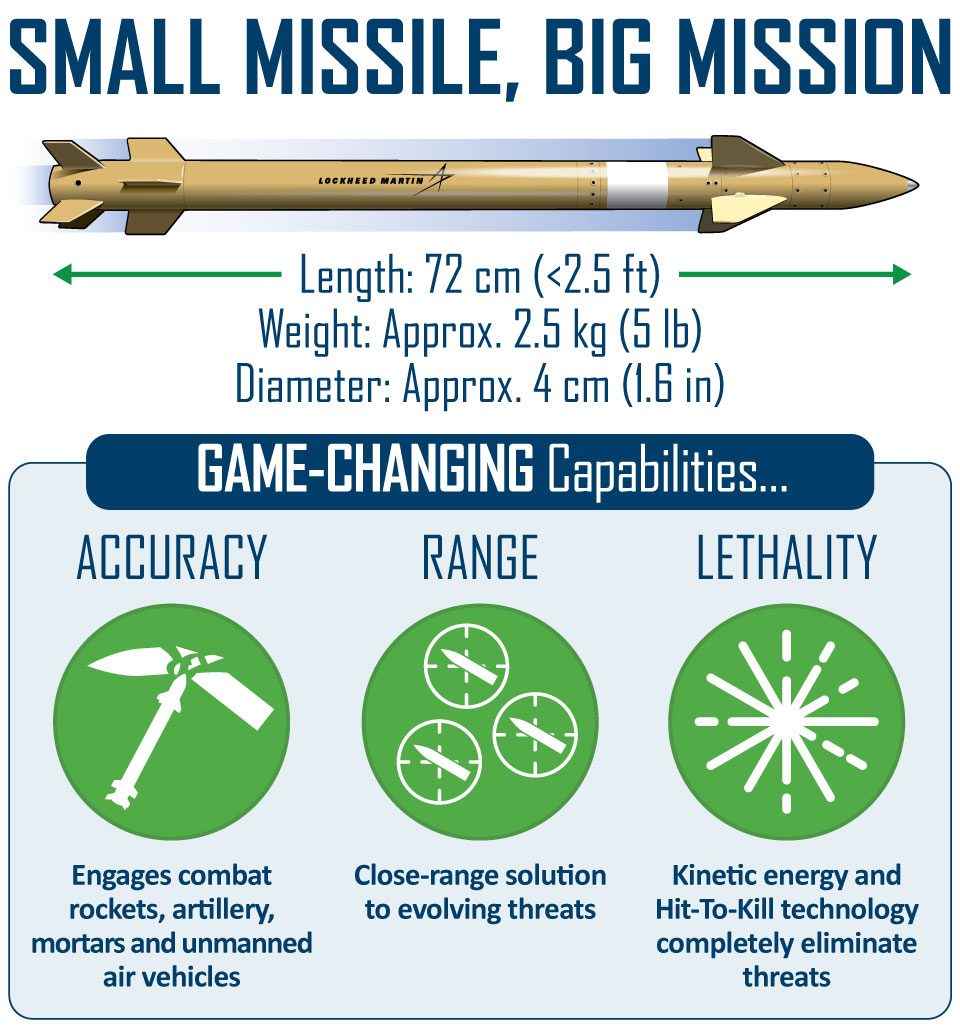

Lockheed Martin, supported by the US Army’s Aviation and Missile Research Development and Engineering Centre (AMRDEC), has completed a controlled test flight of its improved-design Miniature-Hit-To-Kill (MHTK) interceptor to verify the performance of the missile’s enhanced airframe with an updated electronics package.
Lockheed Martin’s (NYSE: LMT) Miniature Hit-to-Kill (MHTK) missile successfully conducted a controlled flight test in Jan 2018 to demonstrate the interceptor’s increased agility, and to validate the performance of its airframe and electronics — now common between MHTK’s two configurations to drive affordability.
Friday’s test at White Sands Missile Range, New Mexico, was the first ever for MHTK’s updated electronics, and the second for the interceptor’s next-generation airframe. Commonality between the two missile configurations (active and semi-active seeker), and the increased agility demonstrate MHTK’s transformational capabilities to defeat rocket, artillery and mortar (RAM) targets with greater accuracy, reliability and range compared to current systems. Funded by Lockheed Martin, the successful test advances the program’s technical maturity level and builds confidence in the interceptor’s ability to defeat current and evolving threats.
“Today’s global security environment demands agile, close-range solutions that protect warfighters and citizens from enemy rockets, artillery and mortars,” said Bob Saxer, vice president of Air and Missile Defense at Lockheed Martin Missiles and Fire Control. “This test is another successful milestone demonstrating the interceptor’s maturity as well as performance, and we look forward to continuing to build on this success.”
Israeli company Rafael’s Tamir and Lockheed Martin’s new Miniature Hit-to-Kill missile are both being offered to the Army as possible interceptors for the service’s Indirect Fires Protection Capability. The Army is looking for a second interceptor for its multi-mission launcher — part of the IFPC Increment 2 program — having already chosen a first weapon, the Raytheon-manufactured AIM-9X Sidewinder missile.
The Army wants to qualify a variety of interceptors for the system and, in a search for the second one, is looking for capability to counter rockets, artillery, and mortars as well as provide residual cruise missile defense and defend against drones.