

All modern forces depend on unimpeded access to, and use of, the EM spectrum in conducting military operations. Therefore, there is a requirement to gain and maintain an advantage in the electromagnetic spectrum by countering adversary’s systems and protecting one’s own systems. Thus the EM spectrum can no longer be viewed as an enabler, but rather as a primary warfighting domain, on par with land, sea, air and space operations. This is leading to race among all Militaries to introduce innovations in sensors and communications, countermeasures, and counter-countermeasures in an attempt to gain an advantage over their enemies.
The Pentagon in Oct. 2020 released a strategy for military use of the electromagnetic spectrum that could ultimately spur the creation of a new combatant command to oversee those operations. The strategy pushes for new tactics, training, technology, and partnerships that would let the military hop across and hide in frequencies more easily, sense and attack or defend against other actors on the spectrum, and better withstand cyberattacks on the spectrum. DOD is considering its options for sharing and leasing frequencies with the private sector so it can digitally patrol as much of that space as possible. Like many other technology development efforts in DOD, officials want to connect their electronic warfare and spectrum management tools across services to be more responsive and less reliant on a few specific systems built for the EW mission.
Jamming is defined as electronically rendering a circuit or network unusable by disrupting it so it cannot be effectively used as a means of communication for purposes of command and control. Such an attack could be directed against any portion of the communications system and be of extended duration or else just long enough to lose crypto synchronization. Jamming is at the discretion of the enemy. It does not have to be constant or dependent on large fixed sites. . It is cheap to obtain and simple to operate. It can effectively be used surgically or in broadly based attacks. Most commercial as well as military communication Satellites are not protected against Jamming.
Generally, jamming prevents an adversary from using their radar or radio for either offensive or defensive purposes, by placing an interfering signal into the enemy receiver along with the desired signal. Jammers usually use a high power transmitter that mimics the frequencies and modulation used by an opponent to disrupt their receivers and to corrupt the expected information. Jamming can also be used to add spurious signals to radar system returns, fooling the receiving radar to think there are more, or fewer, targets in an area. In some cases, particularly in depriving a user of radio communication, complete transmissions are recorded, altered and retransmitted, making the recipient unsure of the quality of the data.
An electronic-warfare aircraft is a military aircraft equipped for electronic warfare (EW), that is, degrading the effectiveness of enemy radar and radio systems by using radar jamming and deception methods.
The U.S. Air Force has concluded a two-day, $1.4 million that evaluated the F-35 fighter jet’s ability to provide its electronic warfare capabilities to other stealthy reconnaissance and bombing platforms. The event, which took place Aug. 2020 at Nellis Air Force Base, Nevada, tested the ability for the F-35 to provide Suppression of Enemy Air Defense, or SEAD, support for other stealthy platforms such as the B-2 and the RQ-170 reconnaissance drone, according to an Aug. 6 news release from the Air Force.
/cloudfront-us-east-1.images.arcpublishing.com/mco/KRAIJ7NMWNAKHJS3QCHD5XZ5TQ.jpg)
Other platforms that participated included the F-22, the F-15 and the Navy’s E/A-18G aircraft. Some aspects of the scenario tested these fourth- and fifth-generation platforms’ joint and coalition SEAD integration. Other scenarios focused on how the latest fourth-gen electronic capabilities could increase fifth-gen freedom of maneuver, and vice versa, in contested environments, the Air Force said.
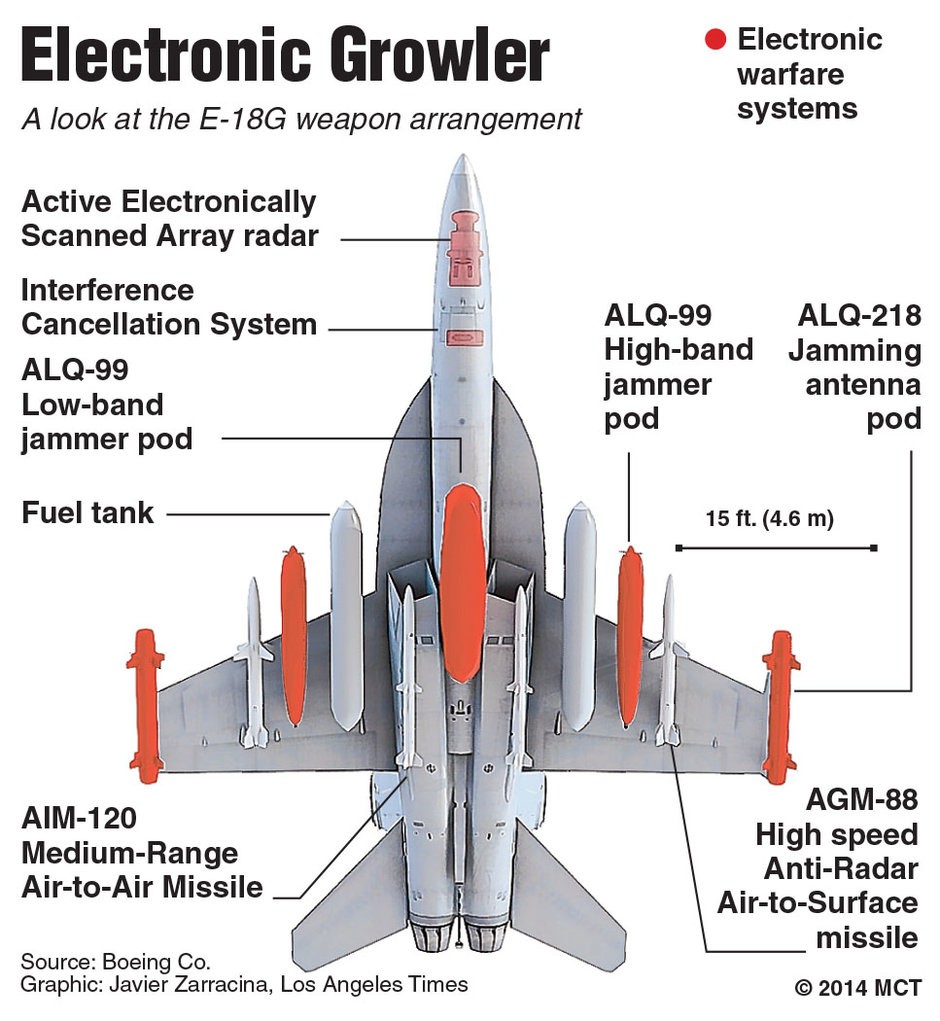
The United States Navy’s EA-18G Growler electronic attack fighters are one of a small number of military aircraft types dedicated to the task of jamming—and potentially destroying—hostile radars that could guide deadly surface-to-air missiles against friendly aircraft. This mission is known as Suppression of Enemy Air Defenses (SEAD). The Growler is derived from the F-18 Super Hornet fighter, and is faster, more maneuverable, and more heavily armed than preceding aerial jamming platforms based on transport and attack planes. This allows the Growlers to contribute additional firepower to strike missions, keep up with fighter planes they are escorting, and potentially approach a bit closer to hostile air defenses.
China, too, has made rapid strides in electronic warfare aircraft as well as developed new GPS spoofing techniques, and has a separate military service specializing in space, cyber and electronic warfare. The fact that China recently showcased electronic warfare vehicles in a military parade in Beijing shows the importance it places on those capabilities.
China has developed its own Growler. The aircraft in question is a variant of the two-seat J-16 Red Eagle strike plane—itself a Chinese copy of the Russian Sukhoi Su-30MKK Flanker. The two-seat Red Eagle is roughly comparable to the American F-15E, and improves upon the Russian original with new avionics including an Active Electronically Scanned Array radar (AESA), the current state of the art in fighter-based radar technology. The J-16D variant—the “D” in the designation comes from the Chinese word for “electronic,” diànzǐ—made its first flight on December 18, 2015. J-16D’s airframe has integrated hardware to make jamming and anti-radar missiles more effective, it probably is designed to use jammers and anti-radar missiles. Most likely, it would carry two to three jamming pods the under the wings and fuselage, each optimized versus different radar frequencies. It is thought that these jammers may also use AESA technology.
Russia is currently dominating the arena of ground-based electronic warfare, the discipline dedicated to detecting and interfering with enemy radar and communication signals while protecting friendly forces from similar effects. Russia is developing a new electronic warfare aircraft, which will be capable to turn off the electronics installed on military satellites, a source from the Russian defense industry told Sputnik.
Electronic-warfare aircraft, such as the EA-18G, have become a fixture of aerial warfare since World War II. Jamming radars, missile-guidance systems and communications networks has become par for the course. For that matter, the Pentagon worries about Russian and Chinese capabilities to jam or spoof GPS links that are key to accurate navigation and targeting.