
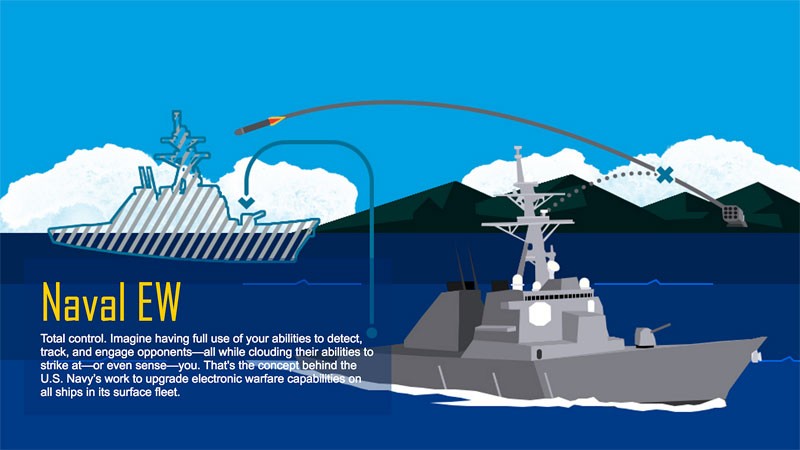

All modern forces depend on unimpeded access to, and use of, the EM spectrum in conducting military operations. Therefore, there is a requirement to gain and maintain an advantage in the electromagnetic spectrum by countering adversary’s systems and protecting one’s own systems. Thus the EM spectrum can no longer be viewed as an enabler, but rather as a primary warfighting domain, on par with land, sea, air and space operations. This is leading to race among all Militaries to introduce innovations in sensors and communications, countermeasures, and counter-countermeasures in an attempt to gain an advantage over their enemies.
Electronic warfare provide means to counter adversary’s systems while protecting one’s own systems through Electronic Attack (EA), Electronic Protection (EP) and Electronic Support (ES). EA is the electronic countermeasure which includes jamming and deception of enemy radars, electro-optic and communication systems. It also includes use of anti-radiation missiles (ARM), electromagnetic pulse (EMP) and directed energy weapons (DEW). Electronic protection (EP) is the ECCM including such measures as emission control (EMCON), communication security (COMSEC) and electromagnetic hardening. Electronic support (ES) includes all actions taken for the purpose of real-time threat reorganization in support of immediate decisions involving EA, EP, weapon avoidance, targeting or other tactical employment of forces e.g. Electronic Intelligence (ELINT) and Communication Intelligence (COMINT).
While electronic warfare has been a priority for the US defense community since World War II, Clark said that recent advances by Russian and Chinese militaries have ramped up US interest in the technology.
The US Navy is courting proposals from defense contractors to design the next generation of electronic warfare (EW) technology. It’s looking for devices that can be used to jam enemy radar and missile systems and deceive hostile forces—and the service branch wants equipment that “goes to 11.” “The saying is, ‘He who controls the electronic spectrum controls the world,’” Stanton Parsons, a former Navy pilot who flew the radar-jamming EA-6A Electric Intruder airplane, told Quartz. “If you don’t control the electronic warfare spectrum, you will lose.”
Reflecting the Navy’s increasing use of small, unmanned ships and drones to augment and extend the capabilities of its existing force, the service branch is looking for ways to use a multitude of these devices to at once create an antenna capable of sending out radio frequencies with the power equivalent to those emitted from “black hole jets” or “gamma ray bursts,” according to documents from a Navy presentation given to defense contractors last month and posted in a federal contracting database.
Those celestial bodies generate extremely large amounts of power at incredibly high frequencies, which “would be very hard to defeat if you’re using that as a sensing technology,” Bryan Clark, a former special assistant to the US chief of naval operations and a senior fellow at the Center for Strategic and Budgetary Assessments, a national security research institute in Washington DC, told Quartz. “Because to jam it an adversary would have to generate equivalent power and generate at a very high frequency,” he added. Clark said that such technology would also potentially be capable of frying enemy electronics with the amount of radiation it generated.