

Ever-growing data generation driven by mobile devices, the cloud, the IoT , and big data, as well as novel AI applications, all part of the megatrends, requires continuous advancements in memory technologies.
RRAM is a nonvolatile memory that is similar to PCM. The technology concept is that a dielectric, which is normally insulating, can be made to conduct through a filament or conduction path formed after application of a sufficiently high voltage. This memristor technology is considered as potentially a strong candidate to challenge NAND Flash. At 16 Gb the Micron-Sony RRAM has the highest density commercialized among emerging NVM technologies.
Because of its greater density, RRAM will be able to use silicon wafers that are half the size used by current NAND flash fabricators. In a single chip, it has nearly 10 times the capacity of NAND flash and uses 20 times less power to store a bit of data. It also sports 100 times lower latency than NAND flash, meaning performance is massively improved, according to Crossbar.
AI has been present in mobile phones for a while now, powering voice assistant features like Siri or the Google Assistant, for example. However, in the previous generation of phones, AI was cloud-based and required an internet connection to be accessed. What is different about AI on the new generation of smartphones will combine the cloud-based AI to built-in AI engines on the hardware. This novelty has been announced by tech giants such as Google, Apple and Huawei.
It will do, through sparse processing, is recognize images, voices and language and process them like data. This means that phones like the Mate 10 will be able to make decisions and optimise their performance based on what they have learnt from being used. In-device AI also promises a better integration of the system with hardware such as cameras, microphones and batteries.
Machine learning is all about having the right and a diverse amount of data. Mobile phones would require large memory to store lots of examples for system training. “There’s a lot of data that you use and supply on your phone that is unique to you, that identifies you. The systems that can do an intelligent analysis of data can determine lots of things about you that you may or may not wish to be determined: your behaviours, your preferences, your health,” added Professor Robertson.
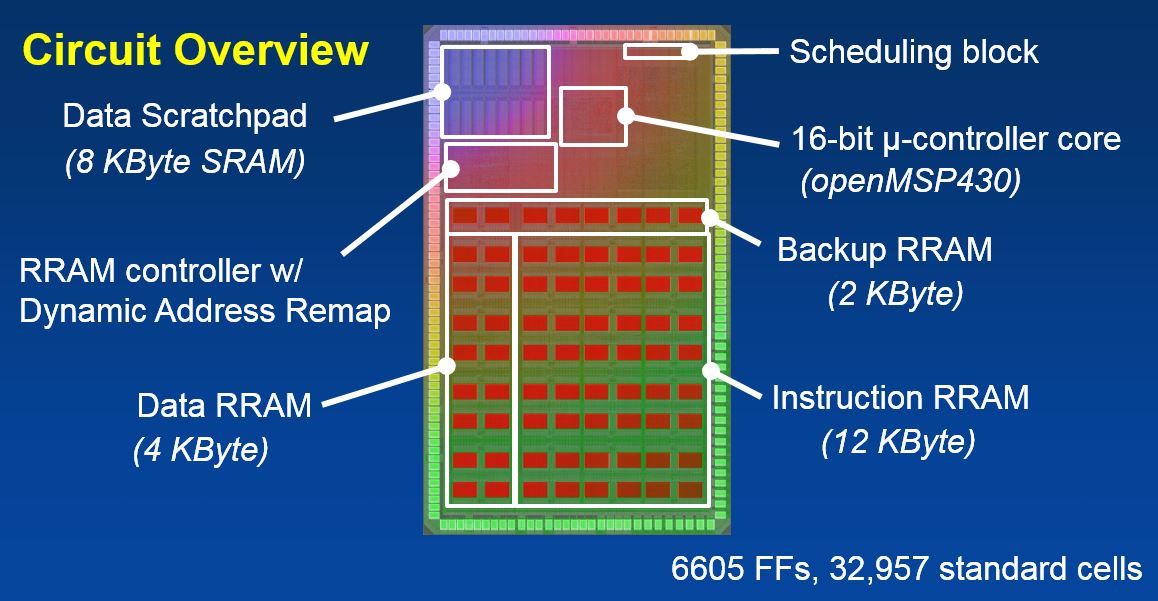
Researchers at CEA-Leti and Stanford University have demonstrated a chip that integrates multiple-bit non-volatile memory (NVM) resistive RAM (ReRAM) with silicon computing units and new memory resiliency features that provide 2.3× the capacity of existing ReRAM. Target applications include energy-efficient, smart-sensor nodes to support artificial intelligence on the internet of things or edge AI.
“The biggest challenge facing engineers for AI today is overcoming the memory speed and power bottleneck in the current architecture to get faster data access while lowering the energy cost,” Dubois said in a press release. Embedding ReRAM in a processor should give that fast access and energy savings, he argues. The company is demonstrating a test chip at the Embedded Vision Summit next week in Santa Clara, Calif. It’s capable of running face recognition and license plate recognition, says Dubois. And it can train to recognize new faces without help from the cloud.