
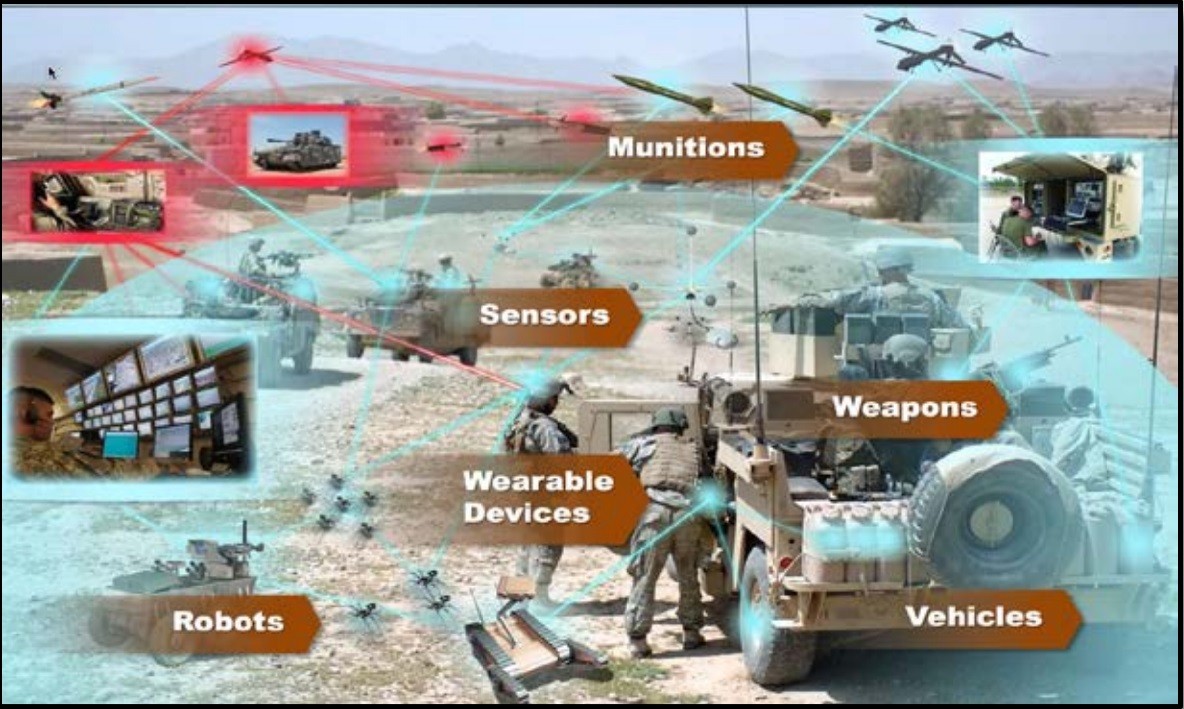

There is great potential for IoT technologies to revolutionize modern warfare, leveraging data and automation to deliver greater lethality and survivability to the warfighter while reducing cost and increasing efficiency. Analogous to IoT, Military internet of things (MIOT) comprising multitude of platforms, ranging from ships to aircraft to ground vehicles to weapon systems, is expected to be developed. MIoT offers high potential for the military to achieve significant efficiencies, improve safety and delivery of services, and produce major cost savings.
Maj. Adam Taliaferro, USA, strategist in the future warfare division of the Army Futures and Concepts Center said, “The Internet of Things has a big effect on our ability to do intelligence, surveillance and reconnaissance,” he says. “It can help us define the operational environment, characterize what’s going on—not only in dense urban terrain but also in large open fields—and it helps us in our ability to make decisions. Another example is intelligent analytics, which combines precision logistics with precision analytics so the force can be resupplied without requests, or materiel can be redirected on priority. “It also may help us in garrison understand how we can secure our bases, employ forces, rapidly shift them,” the major says.
However the successful development and deployment of IoT technologies across the military requires many challenges to be solved. The future billions of Internet of Things (IoT) devices shall be deployed ‘everywhere’ and to be accessed ‘any time’ from ‘anywhere’, anything from large buildings, industrial plants, planes, cars, machines, any kind of goods. The U.S. Army is looking toward the Internet of Things to reshape the future force for multidomain operations. Faced with the challenge of networking vast amounts of diverse sensors, the service views this type of networking as the solution to greater efficiency combined with increased capability.
In order to make effective use of IoT, the devices must be able to connect to global networks to transmit sensor data and receive actionable analytics. One significant challenge when adopting commercial IoT in military operations is that military networks, especially tactical ones, usually do not connect to the Internet or have restricted, limited, and expensive (e.g., using SATCOM) Internet access. There is also unavailability of network services in remote terrains, deserts, oceans, and mountains.Therefore military should invest in resilient, flexible capabilities to extend Internet connectivity in denied areas utilizing technologies like high-altitude communications relay platforms, and Microsatellites.
In October 2017, for instance, the US Army announced it had selected the University of Illinois at Urbana-Champaign to lead a $25 million initiative to develop the scientific foundations of a next-generation internet of battlefield things (IoBT). In the announcement, Army leaders stressed the need for a robust network to make connected devices truly battle-worthy.