

With the rapid development of the aerospace field, fiber-reinforced, resin-based composite materials have gradually replaced traditional metal materials due to their advantages of low density and high strength. An increasingly important innovation in the aerospace industry is the use of composite materials, and they have played a major role in weight reduction. A lower-weight plane is more fuel-efficient because it requires less fuel to propel itself forward. Composites are also incredibly strong and as a result have a higher strength-to-weight ratio, also known as specific strength, than the metals used in making aircraft. In addition, they resist compression and don’t easily break under tension.
Composite materials aren’t prone to corrosion due to harsh chemicals, and they’re resistant to many highly reactive chemicals. They can also handle wide variations in temperature and exposure to severe weather. Another big advantage of composites is their design flexibility: They can be made into just about shape. And a single, oddly shaped piece of composite can replace many pieces made of other materials. That helpful characteristic cuts down on maintenance and so can reduce costs over the lifetime of a plane.
Composites are versatile, used for both structural applications and components, in all aircraft and spacecraft, from hot air balloon gondolas and gliders, to passenger airliners, fighter planes and the Space Shuttle. Applications range from complete airplanes such as the Beech Starship, to wing assemblies, helicopter rotor blades, propellers, seats and instrument enclosures.
Composites are essentially materials made up of 2 or more phases or constituent parts, predominantly plastics reinforced with carbon fibers. They can be formed into various shapes to increase their strength and layered with fibers running in a different directions, to allow designers to form structures with unique properties. The development of next generation composite materials with light-weight and high-temperature resistance will help in designing high-performance, economical aircrafts. Today there are three main types in use: carbon fiber-, glass- and aramid- reinforced epoxy.; there are others, such as boron-reinforced (itself a composite formed on a tungsten core).
Perhaps the biggest disadvantage of composite materials for aircraft and component manufacturers is their higher initial cost compared with metals. The greater cost is largely due to the price of the fibers and the complicated process required to make the finished materials. It can be difficult to tell when the interior structure of a composite aircraft piece has been damaged. That makes inspections difficult and more costly.
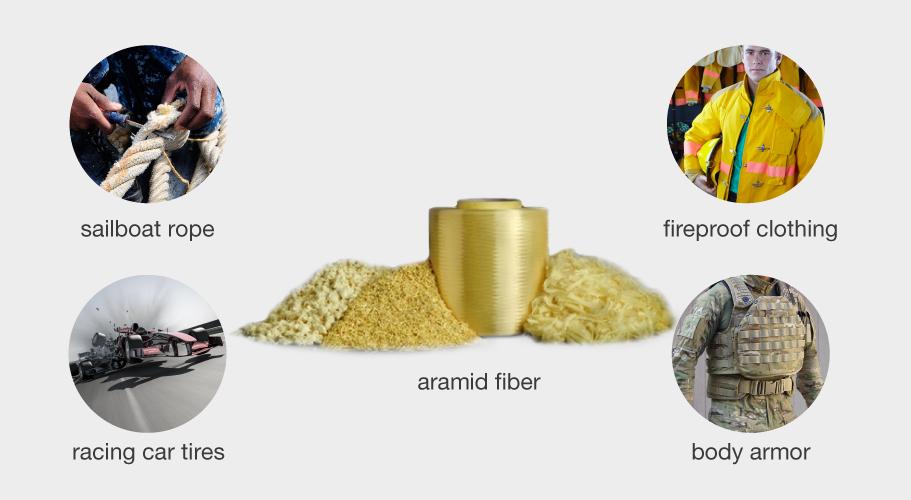
Structural fibers such as carbon, glass and aramid fibers have been intensively adopted in high-performance applications.Aramid fibers form an important group of fibers for composite applications. These applications range through light-weight shell structures, protective structures in ballistic applications such as helmets and various shields, protective clothing, and car tires, for instance.