
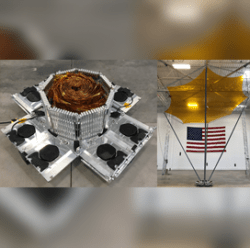

The small satellite is one of the fast growing sectors in space industries. Small satellites usually refer to satellites below 500 kg, including minisatellite (100–500 kg), microsatellite (10–100 kg), nanosatellite (1–10 kg), picosatellite (0.1–1 kg), and femtosatellite (<0.1 kg).
Cube Satellites, aka CubeSats, are a class of nano satellites that have gained popularity recently, especially for those that consider CubeSats as an emerging alternative to conventional satellites for space programs. This is because they are cost-effective, and they can be built using commercial off the-shelf components. Moreover, CubeSats can communicate with each other in space and ground stations to carry out many functions such as remote sensing (e.g., land imaging, education), space research, wide-area measurements, and deep-space communications.
Antennas are key components that enable small satellites to receive and transmit electromagnetic signals. Onboard small satellites, there are a number of antennas for different functions. Due to the limited volume onboard small satellites, it is important to optimize the antenna designs, which directly determine the performance of all wireless systems onboard satellites, such as telemetry, tracking, and control (TTC), high-speed data downlink, navigation, intersatellite communications, intrasatellite communications, wireless power transfer, radars and sensors, etc.
CubeSats are constrained by limited space available for each subsystem, available DC power, and the non-availability of sufficiently large RF aperture for communication and radar payloads. Their mass ranges from 1 to 6 kg and are low power of few watts. Antennas for cubesats is a challenge as the antenna needs to meet several restrictions related to the CubeSat’s size, i.e., ≤10 × 10 × 10 cm3 , weight, i.e., ≤1.3 kg, and power, i.e., ≤2 W while yielding high gain and wide bandwidth.
Moreover, CubeSats have also been considered for deep space missions. While LEO spacecraft may have maximum communication range of only 2,000 kilometers, Cubesats for deep space missions must support at least a 2 million km link back to earth. Since CubeSat RF output power resources are limited, e.g. 5 watt RF, a higher gain antenna is needed to compensate for the factor of 1000 increase in range.
Antennas for Small Satellite High-Speed Data Downlink
Many antenna types with different operating frequency bands are proposed for CubeSat applications. Some of the antenna designs include patch antennas, slot antennas, dipole and monopole antennas, reflector antennas, reflectarray antennas, helical antennas, metasurface antennas and 3 millimeter and sub-millimeter wave antennas. In addition, antennas are also classified according to their operating frequency bands, e.g., VHF, UHF, L, S, C, X, Ku, K/Ka, W and mm/sub-mm wave bands.