

An artificial island or man-made island is an island that has been constructed by people rather than formed by natural means. Artificial islands may vary in size from small islets reclaimed solely to support a single pillar of a building or structure, to those that support entire communities and cities. Human-made islands aren’t a new phenomenon—some in East Asia date back to the 1600s—they’re now being considered as remedies for overpopulation and climate change across the world, and perhaps that shows how desperate the fate of humanity has truly become.
Extending south of China and ringed in by the Philippines, Vietnam, Brunei, and Malaysia is a 1.35 million-square-mile body of water known as the South China Sea. The South China Sea has become a stage for Hong Kong’s dystopic future wherein 1.1 million people, many displaced by a housing crisis, are expected to live on artificial islands within the next 30 years.
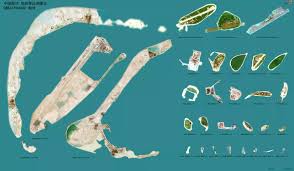
China has caused alarm among its neighbours and in Washington by constructing a series of artificial islands throughout the area on what were previously reefs and partially-submerged islets in the strategically-important waters. China has been transforming the reefs and atolls it occupies on the disputed Spratly Islands since 2015, turning them into artificial islands. The islands function as unsinkable aircraft carriers and help to cement Beijing’s claims on waters rich with fish and minerals, waters that neighboring countries also claim. It has also built airstrips and other military facilities and deployed equipment such as anti-aircraft guns and close-in weapons systems, according to the US think tank the Centre for Strategic and International Studies.
China has built seven artificial islands in the South China Sea and steadily expanded its military assets in this highly strategic area, through which one-third of global maritime trade passes. It has constructed port facilities, military buildings, radar and sensor installations, hardened shelters for missiles, vast logistical warehouses for fuel, water and ammunition, and even airstrips and aircraft hangars on the man-made islands.
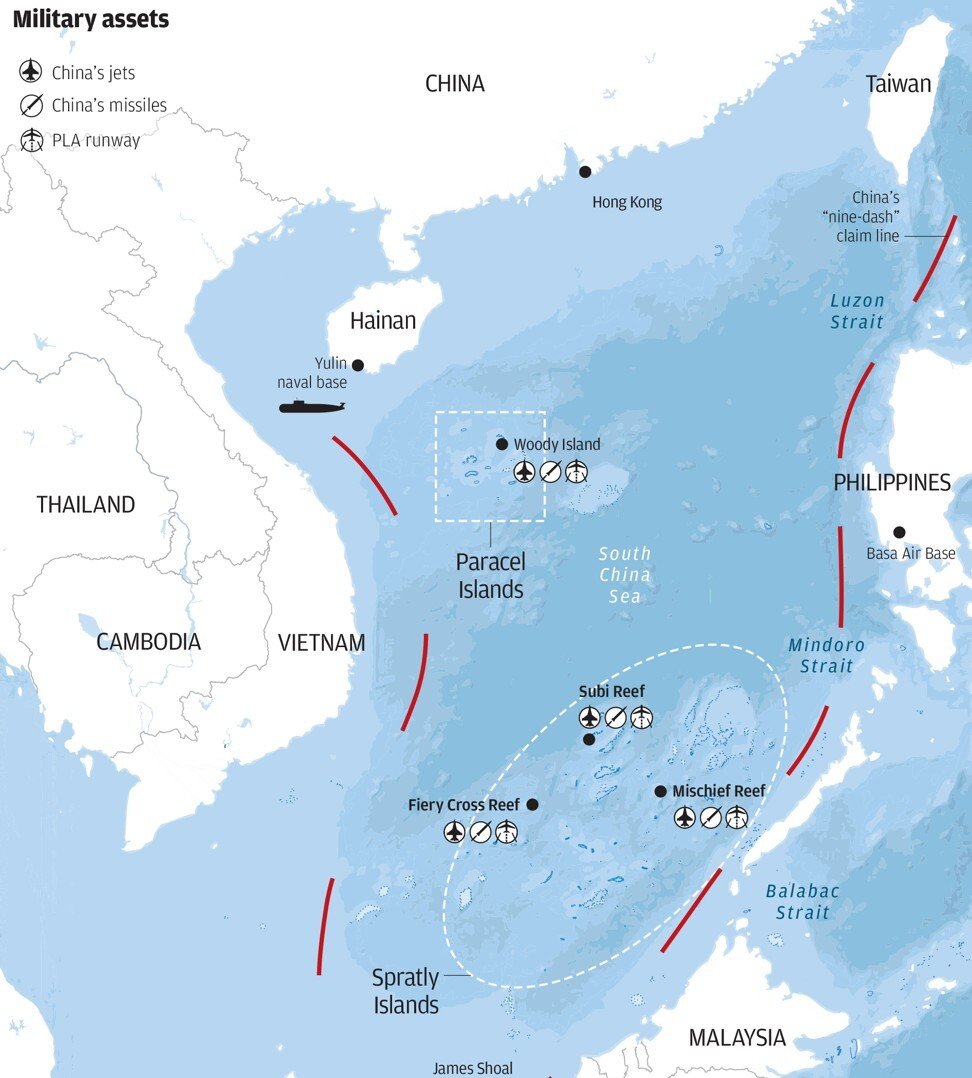
Perhaps the most important installations sit on the Fiery Cross, Subi and Mischief reefs in the Spratly island group. Vietnam, The Philippines, Malaysia, Brunei and Taiwan all also claim the Spratlys.
China said the construction was intended to aid peace in the region, as well as maritime safety and disaster prevention. China lays claim to almost all of the South China Sea, through which more than $5 trillion (£3.8 trillion) of trade passes every year.
U.S. Navy Adm. Philip Davidson told the Senate Armed Services Committee that China can now control the South China Sea “in all scenarios short of war with the United States” because of its increasing military presence there. China has reportedly started to base some aircraft, including bombers, and missile systems on manmade islands in the region, causing concern among other Southeast Asian countries.