
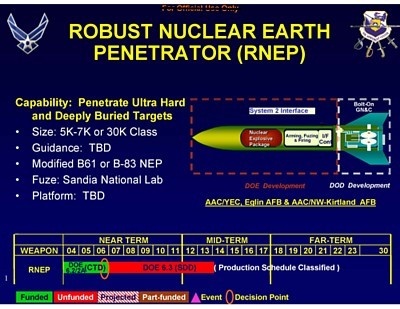

Military studies have shown that adversaries have shifted to the use of underground bunkers to protect against the U.S. military’s precision strike capabilities that combine satellite navigation with guided missiles and bombs. To counter American precision strikes, China, Russia, North Korean, and Iran began burying facilities and hardening them with high-stress concrete and digging deep with advanced tunneling equipment that burrows hundreds of feet under ground and through solid rock.
The Pentagon’s recent nuclear posture review outlining the administration’s nuclear modernization noted the increasing use of hardened underground facilities by adversaries. The report said China and Russia “are fielding an array of anti-access area denial (A2/AD) capabilities and underground facilities to counter U.S. precision conventional strike capabilities.”
For North Korea, the report said, “North Korea relies on hardened and deeply buried facilities to secure the Kim regime and its key military and command and control capabilities. It uses underground facilities and natural terrain features to protect North Korean military forces. Consequently, the United States will continue to field a range of conventional and nuclear capabilities able to hold such targets at risk.”
The study found that underground facilities are used to conceal leaders, military and industrial personnel, weapons, equipment, and other assets. An estimated 10,000 underground hardened targets include about 20 percent that have a strategic function and half of those are in or near urban areas, complicating targeting.
Such facilities, called hard and deeply buried targets (HDBTs), are a serious challenge to U.S. national security objectives of maintaining the capability to hold such adversary assets at risk. Ranging from hardened, surface bunker complexes to tunnel facilities deep underground, HDBTs are typically large, complex, and well concealed, incorporating strong physical security, modern air defenses, protective siting, multifaceted communications, and other important features that make many of them able to survive attack by conventional weapons.
Potential adversaries are increasingly locating HDBTs in basements of multistory buildings located in urban settings, complicating attack planning and increasing the risk of serious collateral effects. This situation places a premium on achieving accurate target characterization so as to obtain the required lethality from precisely delivered weapons during a strike.
The main principles in modern bunker design are largely centered around survivability in nuclear war. As a result of this both American and Soviet sites reached a state of “super hardening”, involving defenses against the effects of a nuclear weapon such as spring- or counterweight-mounted (in the case of the R-36) control capsules and thick concrete walls (three to four feet for the Minuteman ICBM launch control capsule) heavily reinforced with rebar. These systems were designed to survive a near miss of 20 megatons
The Russian continuity of government facility at Kosvinsky Mountain, finished in early 1996, was designed to resist US earth-penetrating warheads and serves a similar role as the American Cheyenne Mountain Complex. The timing of the Kosvinsky completion date is regarded as one explanation for US interest in a new nuclear bunker buster and the declaration of the deployment of the B-61 mod 11 in 1997, Kosvinsky is protected by about 1000 feet of granite. One likely Soviet Union/Russian target, Mount Yamantau, was regarded in the 1990s by Maryland Republican congressman, Roscoe Bartlett, as capable of surviving “half a dozen” repeated nuclear strikes of an unspecified yield, one after the other in a “direct hole”.
Students at Georgetown University discovered thousands of miles of tunnels dug by the Second Artillery Corps, a secretive branch of the Chinese military in charge of protecting and deploying its ballistic missiles and nuclear warheads after translating hundreds of documents, combing through satellite imagery, restricted Chinese military documents and waded through hundreds of gigabytes of online data . The Chinese have called it their “Underground Great Wall” — a vast network of tunnels designed to hide their country’s increasingly sophisticated missile and nuclear arsenal.
Many underground command-and-control complexes and missile tunnels are hidden 328 feet and 1,300 feet below ground in rock or concrete with the majority less than 820 feet deep. Some are as deep as 1,640 feet to 2,296 feet in granite or limestone.