

The need for better radar in World War II drove the development of radio frequency control, and its miniaturization in subsequent decades revolutionized a host of military and consumer applications. The generation of accurate signal frequencies from a single reference oscillator called microwave frequency synthesis, brought about many advanced technologies now critical to the military, such as wireless communications, radar, electronic warfare, atomic sensors and precise timing.
Much like how radio frequency synthesis allows for the precise targeting of a specific radio signal, optical frequency synthesis would allow light to be generated on demand at exact wavelengths with incredible precision. And just like how radio frequency synthesis now has wide ranging applications in today’s consumer products (from GPS systems to smartphones and TV remote controls), optical frequency synthesis will have a significant impact across consumer, scientific and military applications.
However, absolute frequency (or color) of light from a laser is difficult to set with precision, and laser frequencies tend to drift. The development of the “optical frequency comb” garnered a Nobel Prize in 2005, and enabled the demonstration of the first optical frequency synthesizer. Self-referenced frequency combs generated from femtosecond pulses in highly-nonlinear fibers have led to optical synthesizers with record breaking stability and accuracy. These systems, analogous to their radio-frequency counterparts, allow light to be generated on demand at exact wavelengths with errors of less than 10-15 or one-part-per-quadrillion.
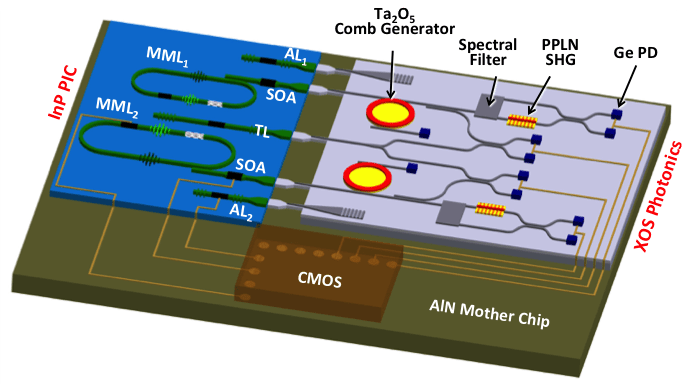
While they provide unprecedented performance, the use of optical frequency synthesizers has been limited to laboratory settings due to the cost, size, and power requirements of their components. To reduce these obstacles DARPA launched the Direct On-Chip Digital Optical Synthesizer (DODOS) program in 2014, that seeks to develop a chip-scale optical frequency synthesizer using a self-referenced optical frequency comb to precisely control the output of a narrowband tunable laser.
The ability to control optical frequency in a widely available microchip could enable a host of advanced applications at much lower cost, including: High-bandwidth (terabit per second) optical communications; sensitive chemical spectroscopy, toxin detection and facility identification; high-precision light detection and ranging (LiDAR); High-performance atomic clocks and inertial sensors for position, navigation and timing (PNT) applications and High-performance optical spectrum analysis (OSA).
Scientists in the Emergent Photonics Lab (EPic Lab) at the University of Sussex have made a breakthrough to a crucial element of an atomic clock—devices which could reduce our reliance on satellite mapping in the future—using cutting-edge laser beam technology. Their development greatly improves the efficiency of the lancet (which in a traditional clock is responsible for counting), by 80% – something which scientists around the world have been racing to achieve.
For example, digital optical synthesizers on a chip could increase accuracy for optical chemical sensing by six orders of magnitude while reducing cost, size and power requirements by many orders of magnitude over current capabilities. These improvements would make it possible to detect adversary chemical production facilities with high sensitivity from much farther away than is possible today.
“The development of optical frequency synthesis has significantly enhanced our ability to accurately and precisely measure time and space,” said Gordon Keeler, the DARPA program manager leading DODOS. “However, our ability to leverage the technology has been limited. Through DODOS, we’re creating technologies that will enable broader deployment and unlock numerous applications. The goal is to shrink laboratory-grade capabilities down to the size of a sugar cube for use in applications like LIDAR, coherent communications, chemical sensing, and precision metrology.”