
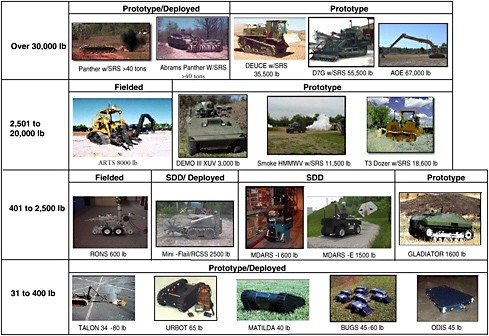

An unmanned ground vehicle (UGV) is a vehicle that operates while in contact with the ground and without an onboard human presence. Generally, the vehicle will have a set of sensors to observe the environment, and will either autonomously make decisions about its behavior or pass the information to a human operator at a different location who will control the vehicle through teleoperation. There are a wide variety of UGVs in use today. Predominantly these vehicles are used to replace humans in hazardous situations, such as handling explosives and in bomb disabling vehicles, where additional strength or smaller size is needed, or where humans cannot easily go. They are also used in industries such as agriculture, mining and construction.
They have been also employed for handling Covid or Coronavirus pandemic. From disinfection and street patrols to food and medicine delivery in quarantine wards, robots are being deployed at the front lines to contain the spread of the novel coronavirus, which has claimed hundreds of lives in China. More than 30 disinfection robots designed and produced by a Shanghai enterprise have entered major hospitals in Wuhan, center of the novel coronavirus outbreak, to combat the epidemic. The white robot has a hydrogen peroxide sprayer on its “head” and nine ultraviolet lamps in its “belly,” and can perform multiple forms of disinfection in environments where humans and machines coexist, according to Pan Jing, CEO of Shanghai TMiRob, the manufacturer of the robot. Navigation technology enables the robot to avoid obstacles autonomously, Pan said.
For Defense foreces Semi-autonomous and autonomous unmanned ground vehicles (UGVs) are changing the way they operate. With increasing capabilities, UGVs are able to avoid human injury and casualty, taking charge of many dangerous, dull and dirty operations across the world. Military applications include surveillance, reconnaissance, and target acquisition. UGVs are highly effective in naval operations, they have great importance in the help of Marine Corps combat; they can additionally avail in logistics operations on to the land and afloat.UGVs are also being developed for peacekeeping operations, ground surveillance, gatekeeper/checkpoint operations, urban street presence and to enhance police and military raids in urban settings. UGVs can “draw first fire” from insurgents — reducing military and police casualties.Furthermore, UGVs are now being used in rescue and recovery missions and were first used to find survivors following 9/11 at Ground Zero.
Countries like US, Russia and China are racing to deploy combat robots and drones on the battlefield and are investing in their research and development to have a military edge over other countries. Various militaries are fielding unmanned systems for surveillance, intelligence, logistics, or attack missions to make their forces or campaigns more effective.
The US Army, under the Combat Capabilities Development Command, has the lead in this regard and the types of unmanned ground systems under development are legion; the most recent induction for use by the field army is the QinetiQ Inc. and Pratt Miller Defense Robotic Combat Vehicle-Light, a purpose-built hybrid electric unmanned ground combat vehicle. Russia has battle-tested the Uran-9 unmanned ground combat vehicle in Syria in 2018 and formally inducted it in its ground force in 2019. The Chinese have also been keeping pace with their development of unmanned ground systems and have introduced Norinco’s Sharp Claw UGV, which was first unveiled at the Airshow China 2014 exhibition in Zhuhai, into the People’s Liberation Army (PLA) in April 2020. Each of these three UGVs can perform a variety of tasks — from intelligence, surveillance and reconnaissance (ISR) to fire support and even logistics delivery or casualty evacuation — within their operating parameters.
In India, the DRDO has developed and fielded remotely operated vehicles for several military tasks, from explosive ordnance detection and disposal to chemical, biological, radiological and nuclear reconnaissance,
The US Air Force deployed four-legged “robot dogs” to defend its perimeters during a recent field test in Sep 2020. The “robot dogs” the Air Force was testing are called Vision 60 and were built by Ghost Robotics, and they look a bit like the villains in the “Metalhead” episode of “Black Mirror.” They’re designed to conduct remote inspection, surveillance, or mapping missions, as The Drive reports, and could be used to patrol perimeters at air bases as well. A top British intelligence expert had claimed that the US military will have more robot soldiers on the battlefield than real ones by 2025, suggesting that deadly combat robots are rapidly becoming a reality of modern day warfare.
According to Russia’s deputy prime minister Dmitry Rogozin, the robots will save lives: “We have to conduct battles without any contact, so that our boys do not die, and for that it is necessary to use war robots,” he said. Putin while talking to students envisioned a future for war where drones, ostensibly controlled by artificial intelligence, would fight proxy wars between countries. “When one party’s drones are destroyed by drones of another, it will have no other choice but to surrender,” he said.
The Chinese Army is preparing to deploy small tracked unmanned ground vehicles (UGVs) armed with machine guns, night-vision, missile loaders, and cameras to launch attacks while leaving manned systems at relatively safe stand-off distances. Citing a China Central Television segment on the robots, People’s Online Daily reports that the thigh-high armed robot looks like a small assault vehicle. Target practice results showed the robot has acceptable accuracy.
A report from the Defence Science Board in the US concluded that there are both benefits and dire negatives in using cyborgs to fight their battles, but the country needs to act quickly if it does not want to be left behind any further. The report said “there are both substantial operational benefits and potential perils associated with its use.” Robots on the battlefield will be more efficient, result in less casualties and could ultimately be cheaper. The U.S. Army’s UGVs increasingly are capable of much greater levels of autonomy . Initially The Pentagon justified their development with the statement that Russia and China allegedly also design ‘fast-moving, fully-autonomous killing systems’. and US will make robots ‘not to use them’, but to know how they work and how to counter them. However, recently Army leaders say they plan to operate most of its combat formations with robotic systems functioning alongside or in tandem with manned platforms.