

Electromagnetic waves in the millimeter-wave band (with frequencies between 30 and 300 GHz, or wavelengths between 10 and 1.0 mm) have attractive characteristics. One of their features is the wider usable frequency band compared with waves in the microwave band or lower bands. Another feature of using the millimeter-wave band is the fact that it becomes possible to design smaller and lighter equipment that utilizes that band. So it is useful to adapt millimeter waves for short-range broadband communication systems, high resolution sensing systems and radio astronomy.
The most attractive feature of millimeter waves, when compared with optical, infrared, and terahertz waves, is their ability to penetrate obstacles. And a spatial resolution higher than that achievable with microwave imaging sensors is possible. Therefore, they can be used under low-visibility conditions such as in fog, rain, dust, or fire, where optical or infrared cameras cannot be used.
These sensors are useful for finding landmines, for offering all-weather vision, for detecting cracks in exterior walls, and for screening people for skin cancer. Researchers at Stevens Institute of Technology have developed a millimetre-wave imaging technique that can detect skin lesions and determine whether they are cancerous or benign. In future, they plan to incorporate the technology into a handheld device that will rapidly diagnose skin cancers without the need for biopsy (IEEE Trans. Med. Imag. 10.1109/TMI.2019.2902600). Since millimetre-wave imaging does not require tissue processing or staining, it can be performed promptly, enabling diagnosis of tumours at an early stage. A handheld scanner could also be used to generate real-time 3D images of tumours to guide surgeons, eliminating the need for multiple biopsies to fully remove cancerous tissue.
The imaging system uses millimetre waves (30–300 GHz), which penetrate up to 1.3 mm into tissue, making them highly effective for sensing pathological changes in different skin layers. To improve the resolution of the acquired images, the team developed an approach called “synthetic ultrawideband millimetre-wave imaging” to create an imaging system with a synthetic bandwidth of 98 GHz.
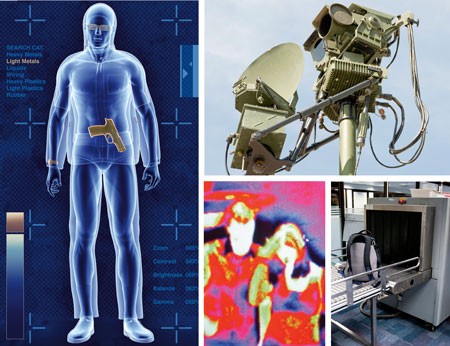
Their most promising application is for security. As the radiometric temperatures of an object are different depending on its metallic or dielectric properties and its temperature, the sensors can detect concealed weapons or explosive materials. Consequently, these sensors have undergone test installation for use in security cameras at the entrances of airports and buildings.
Millimeter-wave technology for application in security screening and imaging has been an area of intense research over the last few years because of the possibility to confer both acceptable spatial resolution (mm-level) and penetration of clothing and some packaging materials using non-ionizing radiation.