
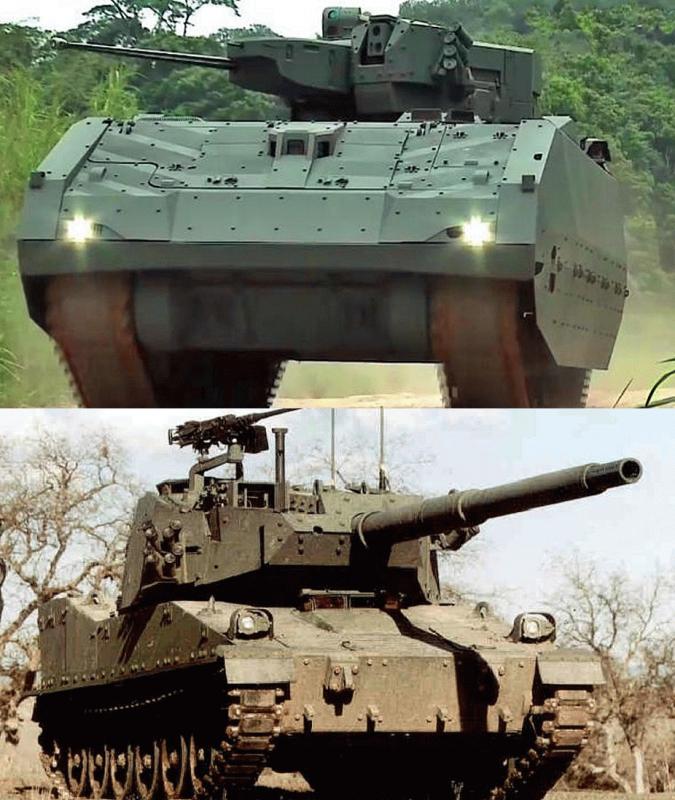

Since the creation of the main battle tank during World War I, there has been a constant arms race between the development of anti-armor weapons and vehicle protection systems, however “Weapons’ ability to penetrate armor, however, has advanced faster than armor’s ability to withstand penetration”. The traditional protection technique depends on the amount of armor, has reached a practical limit for today’s threat environments, as main battle tanks and infantry fighting vehicles have reached weights approaching 70 tons.
The trend of increasingly heavy less mobile and more expensive combat platforms has limited Soldiers’ ability to rapidly deploy and maneuver in theater and accomplish their missions in varied and evolving threat environments. Moreover, larger vehicles are limited to roads and bridges they are able to travel on, require more logistical support and are more expensive to design, develop, field and replace. Militaries are now looking for light tanks which trade less armor for more mobility on the battlefield.
A light tank is a tank variant initially designed for rapid movements in and out of combat, to harass and outmaneuver heavier tanks. It is smaller in size with thinner armor and less powerful main gun, tailored for better tactical mobility and ease of transport and logistics. They are primarily employed in the screening, armoured reconnaissance, skirmishing, artillery observation, and supplementing landing operations in a fire support role of expeditionary forces where larger, heavier tanks are unavailable or have difficulties operating safely or efficiently.
The modern light tank supplements the main battle tank in expeditionary roles and situations where all major threats have been neutralized and excessive weight in armor and armament would only hinder mobility and cost more money to operate. They have also been used for reconnaissance and in some cases, infantry support.
They have important advantages over heavier tanks in Southeast Asia and other nations in the Equatorial region. Their compact dimensions and short to nonexistent barrel overhang lets them maneuver through thick rain forests, and their weight reduces the risk of getting stuck in mud, and simplifies recovery of stuck or damaged tanks. This makes the light tank the preferred choice for infantry support in Equatorial nations.
Some light tanks such as the PT-76 are amphibious, typically being propelled in the water by hydrojets or by their tracks. Most amphibious light tanks weigh little and often utilize aluminum armor. Some light tanks require no modifications for river crossings. Crews simply raise the easily accessible cloth sides around the hull, cover the hatches, turn on the bilge pump and shift the transmission to water operations. Often, a fold down trim vane is erected to stop water from flooding into the hatch.
Some light tanks, such as the M551 Sheridan armored reconnaissance vehicle, could be rigged for low-velocity airdrops from cargo aircraft.With this method the tank is pulled out of the aircraft by brake chutes and skids to a stop. The crew does not ride in the tank during extraction, but parachutes from another plane. Upon landing, they go to their tank, release the lines, and drive it away.
Light tanks has also been considered useful in High altitudes for Mountaneous warfare. In June 2020, Chinese run state media, including the government’s mouthpiece Global Times highlighted new weapons optimised by the People’s Liberation Army for high-altitude warfare including two types of helicopters and a light tank. On June 2, the Global Times reported that the People’s Liberation Army in Tibet “sent troops to a high-altitude region at an elevation of 4,700 meters at night for infiltration exercises behind enemy lines…” China’s new-generation lightweight battle tank has already into service, as the military seeks to boost combat ability in high-altitude areas. The Type 15 light tank has better mobility than other tanks used by the People’s Liberation Army and will strengthen combat readiness in plateau regions such as Tibet, military analysts said.
However, Light tanks are limited by line of sight limitations in mountains and will depend on drones or satellites for getting target coordinates.
India is developing light tanks for Mountain Warfare
The Indian and Chinese armies were locked in a bitter standoff in multiple locations in eastern Ladakh since may 2020. The tension escalated manifold after a violent clash in Galwan Valley in which 20 Indian Army personnel were killed. The Chinese side also suffered casualties but it is yet to give out the details. According to an American intelligence report, the number of casualties on the Chinese side was 35. China’s rise and assertive behaviour in the Indo-Pacific Region—as demonstrated most recently by the June 15 clashes between Chinese and Indian troops in the Galwan Valley region —has contributed to a strategic convergence between the United States and India.
India’s Ministry of Defense has initiated the process of acquiring light battle tanks which can be easily air-lifted to the mountainous ranges near the border with China. Currently, the only operators of the 2S25 are the Russian airborne troops with 24 of these vehicles in service. The Indian Army has been asked to formulate requirements for a light tank weighing up to 25 ton. This development can be viewed in the light of the recent trial of 35-ton Xinqingtan light tank by China in the Tibetan Plateau. It is also an addition to the preparation being made by the Indian Army for acquiring fourth-generation warfare capability.
Amid the ongoing war between Russia and Ukraine, India has given in-principle approval for indigenous design and development of light tanks for mountain warfare, a need for which was felt during the current stand-off with China at the Line of Actual Control (LAC). The Russians had earlier offered its Sprut light tanks to the Indian Army — a proposal that is being considered — even as private firm Larsen and Toubro was working with the DRDO to convert the tracked 155 mm howitzer Vajra into a light tank,
The Russian Sprut-SD is light tank designed to defeat tanks, hard-skinned material and enemy manpower by airborne and amphibious landing forces, as well as by specially designated units of ground forces. Currently, the only operators of the 2S25 are the Russian airborne troops with 24 of these vehicles in service. The Republic of Korea and has expressed interest in acquiring the 2S25 Sprut-SD.
Indian Army are likely to be purchased from Russia as India has already exhibited interest in Russia’s 2S25M Sprut-SDM that is based on a chassis using the technology of BMD-4M and has fire control elements of the T-90MS main battle tank.
In 2023, Indian Army will soon have Light Weight Tanks which have been made in India in collaboration with Defence Research and Development Organisation (DRDO) and Larsen & Toubro (L&T). The making of the Light Weight Tank comes under Make-I, or “government-funded” project category. In an exclusive conversation with Financial Express Online in New Delhi, Secretary, Department of Defence R&D and Chairman DRDO Dr G Satheesh Reddy said, “Work on the Light Weight Tank is going on in full swing. By 2023 the tank will be fully ready for production.