
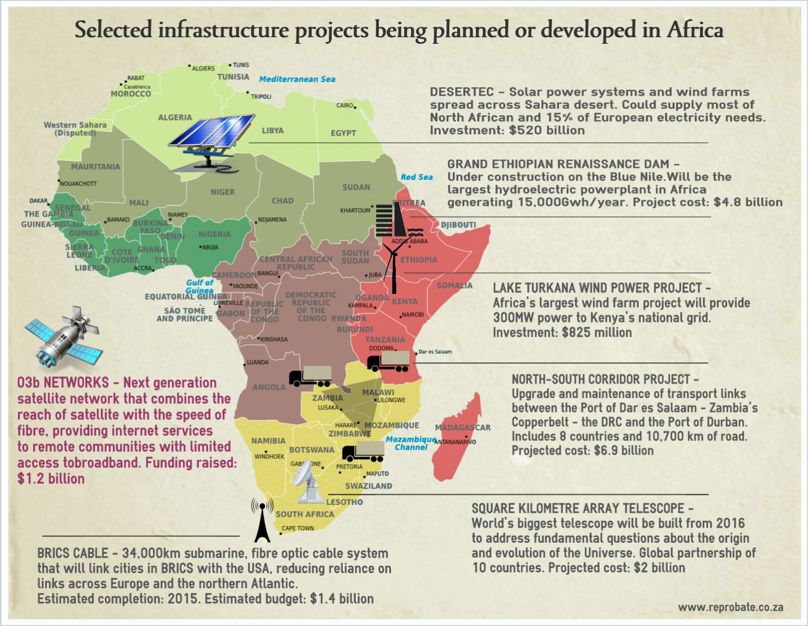

For decades, China’s presence in Africa has largely focused on economic, commercial and peacekeeping activities. Now, Beijing is building on that by establishing greater military links to protect its national assets on the continent and gain greater geopolitical influence.
The world’s second-largest economy has long described Sino-Africa cooperation as a “win-win” arrangement — one that provides China with natural resources and African economies with badly-needed infrastructure. But while the flood of Chinese resources may be welcomed by the region’s cash-strapped governments, the fear is that increased capital could translate into political leverage.
A desire to safeguard Chinese workers and Chinese-funded projects on the continent is likely behind the government’s efforts. “China’s security concerns are actually aimed at its own nationals, and military diplomacy is skillfully used to protect them and their interests,” the Netherlands Institute of International Relations, or Clingendael, said in a recent report.
In Djibouti, where Chinese companies have constructed strategic ports and Africa’s first electric transnational railway, Beijing last year formally launched its first overseas military base, which also operates as a logistics and intelligence facility. Many experts now anticipate more Chinese bases in the years to come, with Namibia rumored as a potential location. The Djiboutian government is about $1.5 billion in debt to Beijing, General Thomas Waldhauser, Commander of US AFRICOM, told Congress earlier this year.
In a white paper issued in July 2019, China has stated that it will continue to set up military facilities abroad. Justifying the same, the white paper said such logistical facilities are required to overcome deficiencies in protecting the country’s overseas interests. It may be noted that China has built a military support base in Djibouti in Africa.
“The PLA (People’s Liberation Army) actively promotes international security and military cooperation and refines relevant mechanisms for protecting China’s overseas interests,” the white paper titled ‘China’s National Defence in the New Era’ stated. “To address deficiencies in overseas operations and support, it builds far seas forces, develops overseas logistical facilities, and enhances capabilities in accomplishing diversified military tasks,” the white paper issued by the State Council’s information office stated.
Meanwhile in Tanzania, where the state-run conglomerate China Merchants Holdings International is hoping to invest in the Bagamoyo mega port, China built a complex designed to train local armed forces earlier this year. And, at the first-ever China-Africa Defense and Security Forum in Beijing, the communist state announced it will provide African countries with “comprehensive support” on matters such as piracy and counter-terrorism. That includes providing technologies, equipment, personnel and strategic advice, local media reported.
The People’s Liberation Army conducts regular joint training exercises across the region and, in certain countries that are home to major Chinese infrastructure projects under the Belt and Road initiative, the communist state has been especially active.
This is causing substantial concern among US officials and prompting discussion of a stronger commitment. 2017 report from the DoD-backed “African Center for Strategic Studies” not only raises concern about Chinese moves to acquire and exploit the countries’ natural resources, but also reports that, in 2015, the Chinese were the second largest arms provider to Africa behind only Russia.
Between 2013 and 2017, Chinese arms sales increased by 38 per cent from the previous five-year period, with Africa accounting for 21 per cent of China’s arms exports, according the Stockholm International Peace Research Institute. “Unlike the US and its allies, China is probably the only arms provider that has no additional political preconditions to major arms sales,” Zhou added.
“In recent years, Chinese arms sales to Africa have surpassed the United States,” said Luke Patey, senior researcher at the Danish Institute for International Studies: “In particular, Chinese small arms and light weapons have spread rapidly since China is less inhibited by selling arms to countries in the midst of conflict than Western providers.” That goes hand in hand with Beijing’s expanding military cooperation, he continued.