
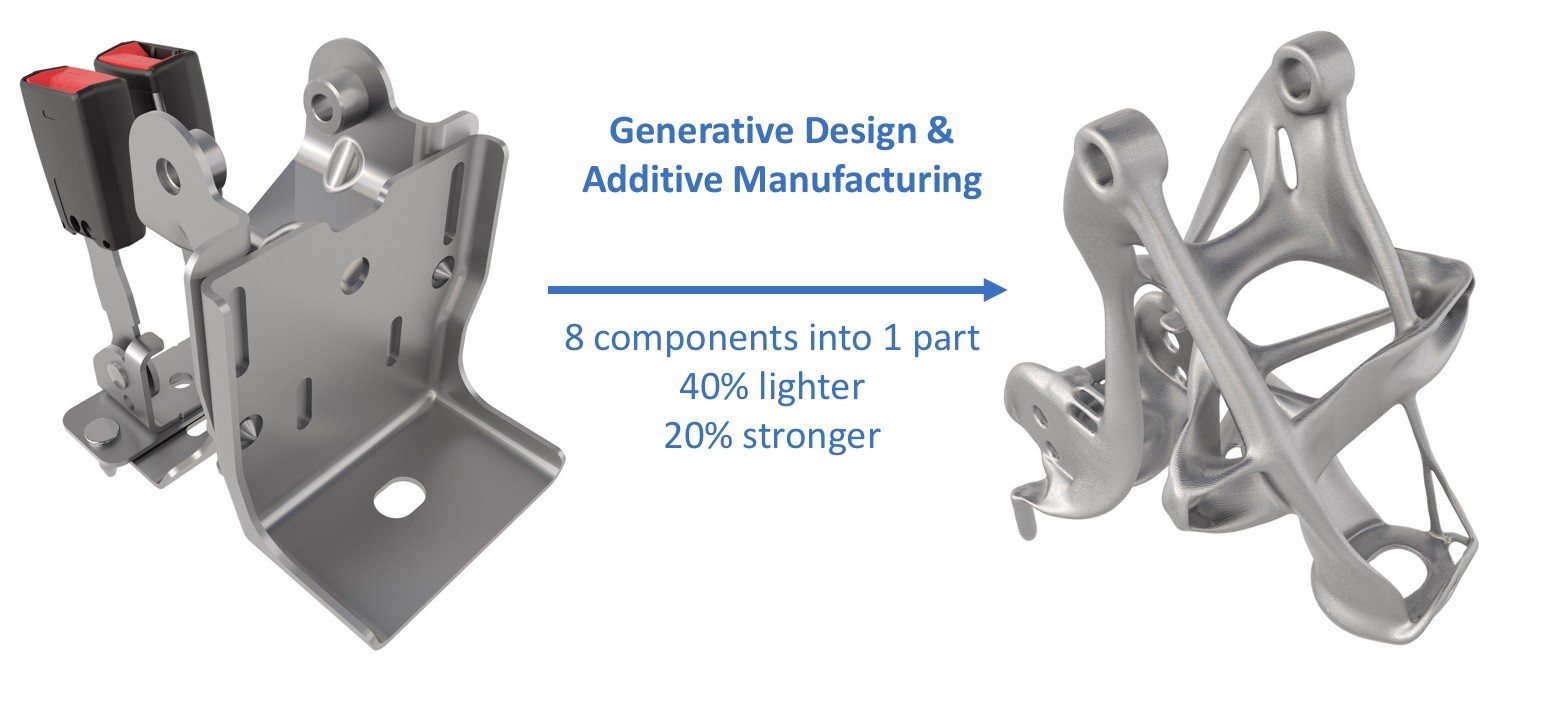

Manufacturing today benefits from three waves of innovation: new production techniques (like 3-D printing), new design methods (like generative design, also driven by A.I.) and new materials, said Marco Annunziata , Co-Founder of Annunziata.
These three waves of innovation are interdependent and mutually reinforcing: 3-D printing allows us to fabricate any complex object, yielding greater resistance, lighter weight and better performance; Generative Design autonomously produces mechanical designs to satisfy objectives and constraints, where A.I. helps us break free from the mental constraints acquired through decades of traditional manufacturing methods; new materials can in turn broaden the range of possible design solutions.
Generative design tools that produce optimum forms for products and buildings without human intervention are set to transform both the physical world and the role of the designer, according to software experts. The software can automatically make aircraft lighter, buildings stronger and trainers more comfortable – with the designer acting as a “curator”, rather than making all the decisions.
Many designers are experimenting with generative design to produce new forms and improve existing products. Under Armor is taking the lead in using this procedure in the manufacture of more efficient sports shoes. However, other companies such as Airbus and Lightning Motorciyle are receiving assistance from Autodesk to improve efficiency in their products. These processes are proving to save time, increase creativity, save money and, finally, create very efficient geometries.
You—of limited creativity, favoring tradition, the straight and square, clinging to the tried and true with a predilection towards parts that can be machined or molded, etc.—are never going to think of breakthrough designs. Generative design, by comparison, is the free spirit, able to explore the full range of possibility.