
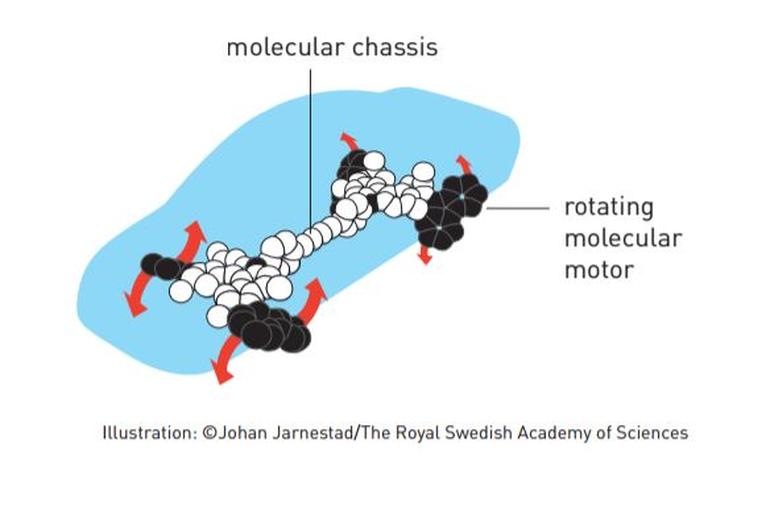

The modern world is filled with macroscopic machines that perform work that we either find demanding or function in places or on length scales in which we cannot act. To date however, we have yet to develop a functional nanotechnology that operates on the scale of molecules or assemblies of molecules. Scientists from a range of disciplines are working to understand, design, and create the next generation of switches and motors to mechanize our world from the bottom up.
Molecular machines can be defined as devices that can produce useful work through the interaction of individual molecules at the molecular scale of length. A convenient unit of measurement at the molecular scale would be a nanometer. Hence, molecular machines also fall into the category of nanomachines. Molecular machines depend on inter- and intramolecular interactions for their function. These interactions include forces such as the ionic and Van der Waal’s forces and are a function of the geometry of the individual molecules.
Molecular machines can be subdivided into three broad categories—protein based, DNA-based, and chemical molecular motors. A majority of natural molecular machines are protein based, whereas the DNA-based molecular machines are mostly synthetic. Nature deploys proteins to perform various cellular tasks, from moving cargo to catalyzing reactions, whereas DNA has been retained as an information carrier. Hence, it is understandable that most of the natural machinery is built from proteins.
In biology, macromolecular machines frequently perform tasks essential for life such as DNA replication and ATP synthesis. The term is also common in nanotechnology where a number of highly complex molecular machines have been proposed that are aimed at the goal of constructing a molecular assembler.
A wide variety of artificial molecular machines (AMMs) have been synthesized by chemists which are rather simple and small compared to biological molecular machines. The first AMM, a molecular shuttle, was synthesized by Sir J. Fraser Stoddart. A molecular shuttle is a rotaxane molecule where a ring is mechanically interlocked onto an axle with two bulky stoppers. The ring can move between two binding sites with various stimuli such as light, pH, solvents, and ions.
Molecular machines have applications in various fields, including medicine, space exploration, electronics and military.
The advances in molecular machines may enable future molecular robots. U.S. military may manufacture combat parts and supplies on the battlefield using robots made of molecules all working together as part of a molecular factory. The nanoscale factories could revolutionize military logistics by eliminating the need to transport or store parts and supplies for every possible contingency. The same technology may prove useful for tying together strands of molecules for superstrong, lightweight armor.
The potential benefits go far beyond the military, however. In addition to producing medicines and antidotes, molecular robots could help cure diseases caused by genetic disorders. The National Human Genome Research Institute lists nearly 50 such disorders, including autism, various cancers, cystic fibrosis and Parkinson’s disease. “We could one day perhaps replace those [genes] with artificial ones. It would be like molecular prosthetics,” Leigh says. “Using a molecular prosthetic may enable a disease to be cured.”