
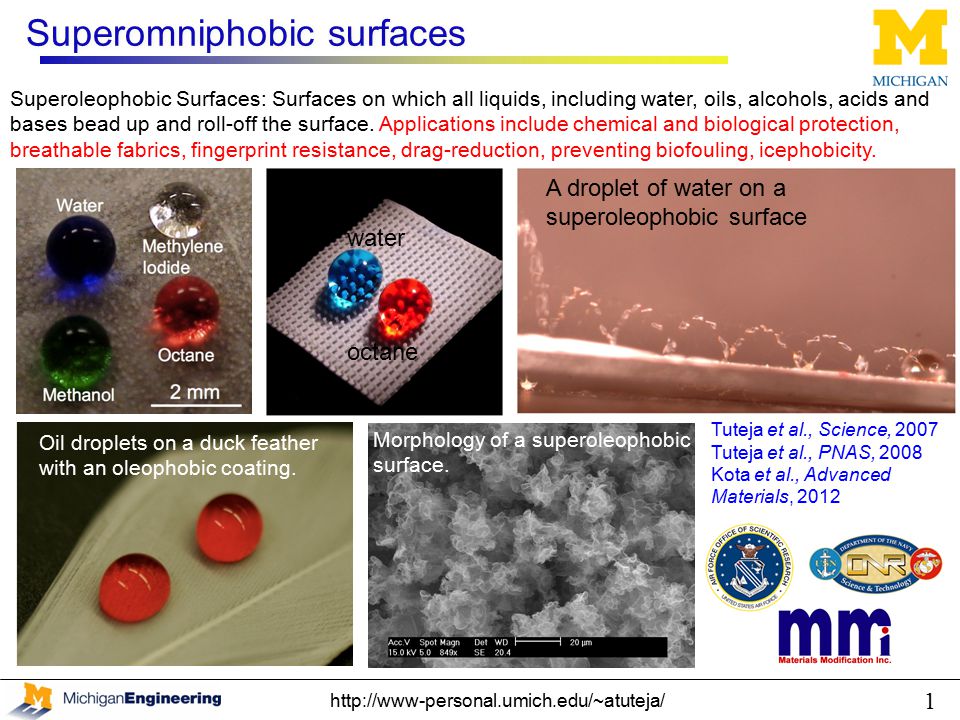

Normal solid surfaces are wetted by liquids such as water and oil. In many cases, surface wetting is undesirable due to the fact that the liquids may largely deteriorate the functionality of the surface, or cause unwanted effects. For example, evaporation of liquid droplets could leave behind chemical or dirt residue on the surface; soot and oily deposits may contaminate the surfaces and they are normally hard to remove without scrubbing.
The utility of omniphobic surfaces stems from their ability to repel a multitude of liquids, possessing a broad range of surface tensions and polarities, by causing them to bead up and either roll or slide off. These surfaces may be self-cleaning, corrosion-resistant, heat-transfer enhancing, stain-resistant or resistant to mineral- or biofouling. The majority of reported omniphobic surfaces use texture, lubricants, and/or grafted monolayers to engender these repellent properties.
Under certain conditions, military coatings can become soiled or contaminated by oil or water borne chemical agents, or oily matters from engine exhaust. Surface coatings that are durable and self-cleaning are desirable. This kind of coating has to be both hydrophobic and oleophobic so that contaminants won’t adhere to the coating surfaces and will come off easily.
“On the battlefield, the soldiers don’t have field laundering equipment. In the event they get clothing dirty…they can just stand up and eventually the dirt will just fall off and the uniform is clean again,” says Truong.
The US Navy’s Office of Naval Research (ONR) is sponsoring the development of a new type of ‘omniphobic’ ship coating that is intended to help reduce fuel and energy costs. The U.S. Navy wants a slick new material that can shed any liquid or semi-liquid that comes into contact with it. When applied as a coating to the hulls of ships and submarines, the “omniphobic” material will immensely reduce friction drag, allowing the sea-going craft to travel faster without using as much energy or fuel, an article in Science Daily reported.