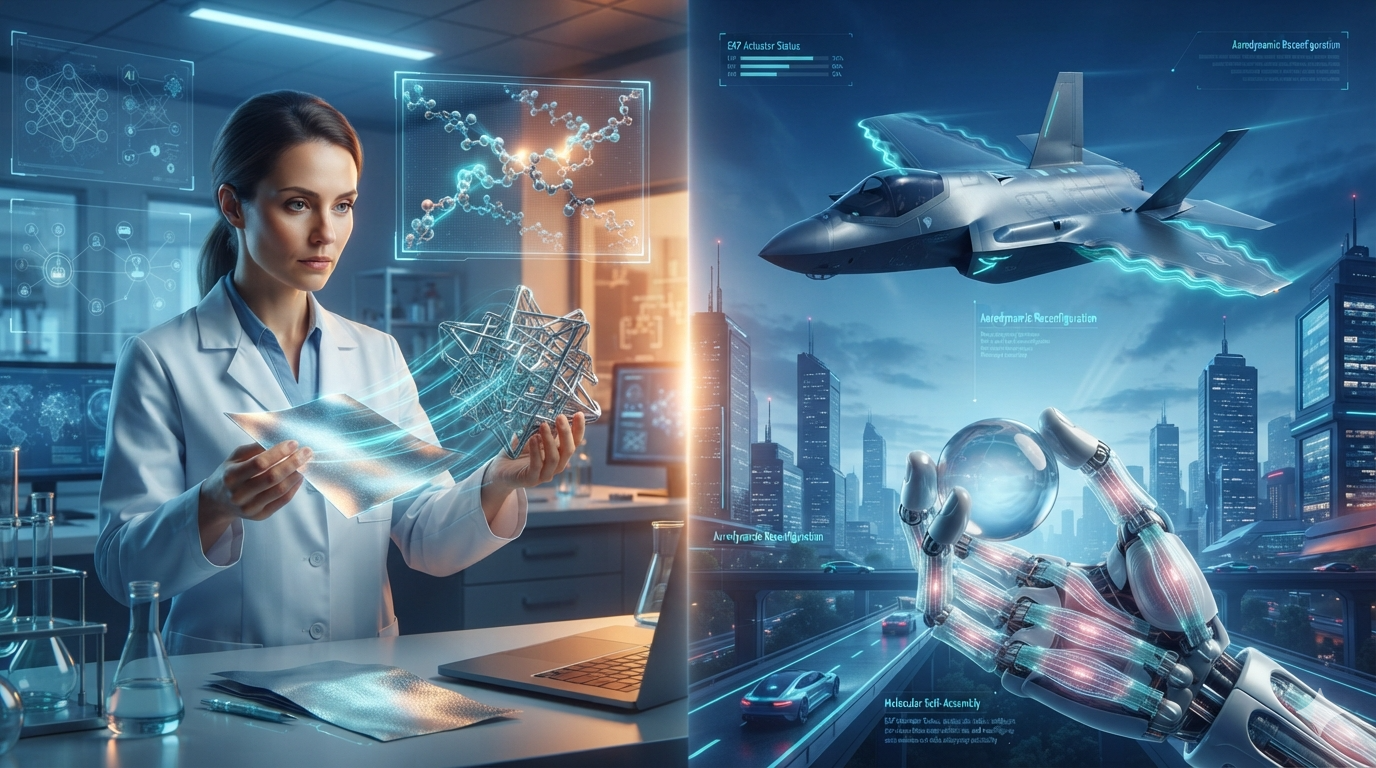
New Smart and multifunctional materials and technologies for Intelligent future, Automotive, Robotics, Aerospace and Defence Industry

Smart materials or Active materials or Functional materials are designed materials that have diverse, dynamic features that enable them to adapt to the environment. They have one or more properties that can be significantly changed in a controlled fashion by external stimuli, the stimulus and response may be mechanical, electrical, magnetic, optical, thermal, or chemical.


Smart materials include self-healing materials, coatings with damage sensing, chemical sensing, friction changing, hydrophobicity changing capabilities, and also materials with several “smart” capabilities. They derive smart properties from structural patterning, often at the micro- or nanoscale, of already known material chemistries.


The multifunctional materials and composites achieve high functionality area, which intendeds to improve processes and products, creates several avenues to increase sustainability, and makes a direct and positive impact on economic growth, environment, and quality of life. They have tremendous potential to impact new system performance by reducing size, weight, cost, power consumption, and complexity while improving efficiency, safety, and versatility.


Smart materials are used to construct smart structures. A smart structure is a system containing multifunctional parts that can perform sensing, control, and actuation; it is a primitive analogue of a biological body. Smart structures are an integration of sensors, actuators, and a control system. Apart from the use of better functional materials as sensors and actuators, an important part of a “smarter” structure is to develop an optimized control algorithm that could guide the actuators to perform required functions after sensing changes.

Smart System or Structure

Leif Asp, a professor at Chalmers University of Technology in Sweden described some of the work he is engaged in to develop carbon fibre composites for vehicles where the frame itself takes on energy storage functions. These structural batteries could mitigate against the usually high load battery masses bring to devices, but as Leif points out their development relies on a large team of researchers from a wide range of disciplines


Numerous examples already exist.  In recent MADMEC competition, a team of PhD students, developed a hydrogel that can be added to the surface of windows, making them switch from transparent to opaque in response to temperature. The hydrogel relies on a custom mixture of polymers that turns opaque as it absorbs heat — up until about 34 degrees Celsius — and then turns transparent and releases heat in response to cooling temperatures. “On a cold day, it’s going to be clear, and on warmer day, if it gets really hot out, it’s going to become opaque,” said team member Seth Cazzell, a PhD student in DMSE. “What we have is this passive, self-shading device that responds to ambient temperature.” Another US university project developed  liquid crystal technology where liquid crystal display intensity. changes instantly according to the external light intensity.


There have been predictions that by 2025 there can be as many as 100 billion connected IoT devices or network of everyday objects as well as sensors that will be infused with intelligence and computing capability while controllable via the Internet.  These devices may include food items, home appliances, plant control systems, equipment monitoring and maintenance sensors, industrial robots, and personal devices such as smart watches, digital glasses and fitness monitoring products. Smart materials  and structures are one of the enabling technologies of this intelligent future.


Military and aerospace also have large demand for smart materials and devices including smart self-repair, smart clothing such as cloaking suits, winglets in aeroplanes that adapt automatically to changing flight conditions and adaptive hull structures for ships. The technology has been used in the head up displays of fighter pilot helmets to enable them to see the visual display even under conditions of rapid change in light intensity like going from bright sunlight into cloud or from cloud into bright sunlight. Smart materials could change shape to unfold a solar panel on a space satellite without need of a battery-powered mechanical device.

IDST Monthly Access Membership Required

You must be a IDST Monthly Access member to access this content.

Join Now

Already a member? Log in here