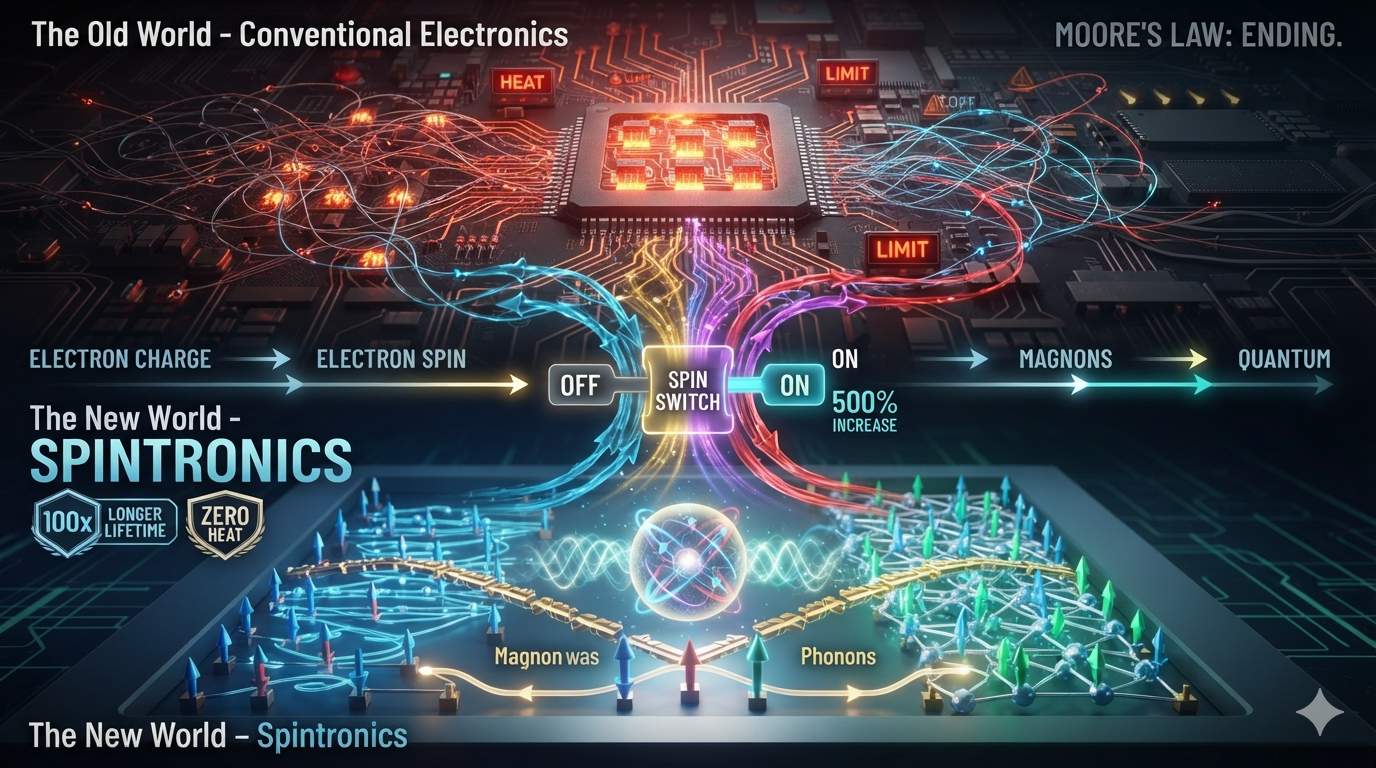
New Breakthroughs enable Spintronic devices

Spintronics is an emerging field of nanoscale electronics which uses not only the charge of electrons but also the spin of electrons. The technology doesn’t require a specialized semiconductor material resulting in reduced manufacturing costs. Other advantages include less energy requirement, as well as low power consumption with competitive data transfer and storage capacity.


Spintronic devices generate little heat and use relatively minuscule amounts of electricity. Spintronic computers would require no energy to maintain data in memory. They would also start instantly and have the potential to be far more powerful than today’s computers. The spintronic devices will find widespread application in civilian and military markets offering new generation of transistors, lasers and integrated magnetic sensors.  It has been used in a variety of devices for information processing, memory and storage — in particular, ultra-high density hard drives and non-volatile memories.


Engineers at the University of California, Riverside, have reported advances in so-called “spintronic” devices that will help lead to a new technology for computing and data storage. They have developed methods to detect signals from spintronic components made of low-cost metals and silicon, which overcomes a major barrier to wide application of spintronics. Previously such devices depended on complex structures that used rare and expensive metals such as platinum. The researchers were led by Sandeep Kumar, an assistant professor of mechanical engineering.


Three independent teams of physicists have unveiled devices that could lead to practical spintronics components of the future. Researchers in the Netherlands have created what they call a “magnon transistor”, whereas a group in China has unveiled their “magnon valve”. Meanwhile in Germany, a team has also demonstrated their own version of a magnon valve. All three devices represent important work towards creating practical spintronics devices that use electron spin to transfer and store information.


In two other scientific papers, the researchers demonstrated that they could generate a key property for spintronics materials, called antiferromagnetism, in silicon. The achievement opens an important pathway to commercial spintronics, said the researchers, given that silicon is inexpensive and can be manufactured using a mature technology with a long history of application in electronics.

IDST Monthly Access Membership Required

You must be a IDST Monthly Access member to access this content.

Join Now

Already a member? Log in here