
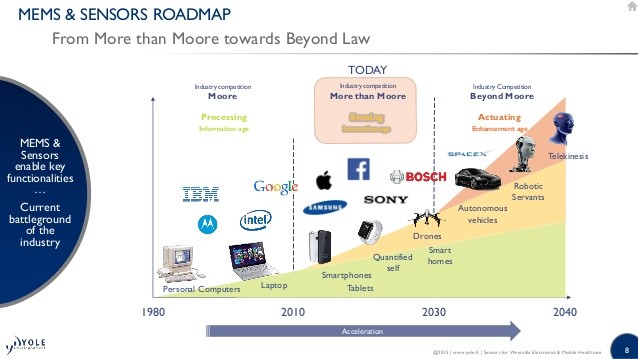

The emerging billions of Internet of Things will need to connect billions of devices deployed in the physical world (the so-called “edge” of IoT) to the cloud, bringing real-world data and analytics to operations. …a challenge with current solutions. Much of the Internet of Things (IoT) is mobile, and sensors play a key role in delivering status information for these connected devices. Sensors ideally need to be small, smart, zero-power and cost-effective. They range from tiny microelectromechanical-systems (MEMS) accelerometers to high-resolution cameras to time-of-flight (ToF) 3D imaging (see “Time-Of-Flight 3D Coming To A Device Near You”). These devices are common fare on smartphones and tablets. MEMS devices are designed to work in concert to sense and report on the physical properties of their immediate or local environment, or, when signaled to do so, to perform some kind of controlled physical interaction or actuation with their immediate or local environment.
Mechanical-Systems (MEMS) is the integration of mechanical elements (levers, springs, deformable membranes, vibrating structures, etc.), sensors, actuators, and electronics (resistors, capacitors, inductors, etc.) on a common silicon substrate through microfabrication technology. MEMS devices are today considered as one among the most promising technologies of this century, capable to revolutionize the industrial world and the commercial product market. Micro-Electro- MEMS can be considered as “intelligent” systems which combine mechanical and electronic functions in extremely reduced dimension. The dimension of a MEMS device is in the order of the microns and it is manufactured directly on a silicon wafer.
The advanced device and process concepts thrust enables the integration and co-location of actuators, sensors, electronics, and power supplies to merge the functions of compute, communicate and power together with sense, actuate and control to change completely the way people and machines interact with the physical world. Some well-known examples of MEMS-enabled functionality in everyday life are airbag deployment in automobiles; motion and orientation detection in smartphones; and blood pressure measurement in IV lines and catheters.
Using an ever-expanding set of fabrication processes and materials, MEMS will provide the advantages of small size, low-power, low-mass, low-cost and high-functionality to integrated electromechanical systems both on the micro as well as on the macro scales. Further, demands for increased performance, reliability, robustness, lifetime, maintainability and capability of military equipment of all kinds can be met by the integration of MEMS into macro devices and systems.
Analyst firm Yole Développement expects the global market for MEMS and sensors to double in the next five years, reaching $100B by 2023, spurred by growth of autonomous mobility products such as Internet of Things (IoT) devices, autonomous cars, fitness and healthcare wearables, and agricultural sensors.