
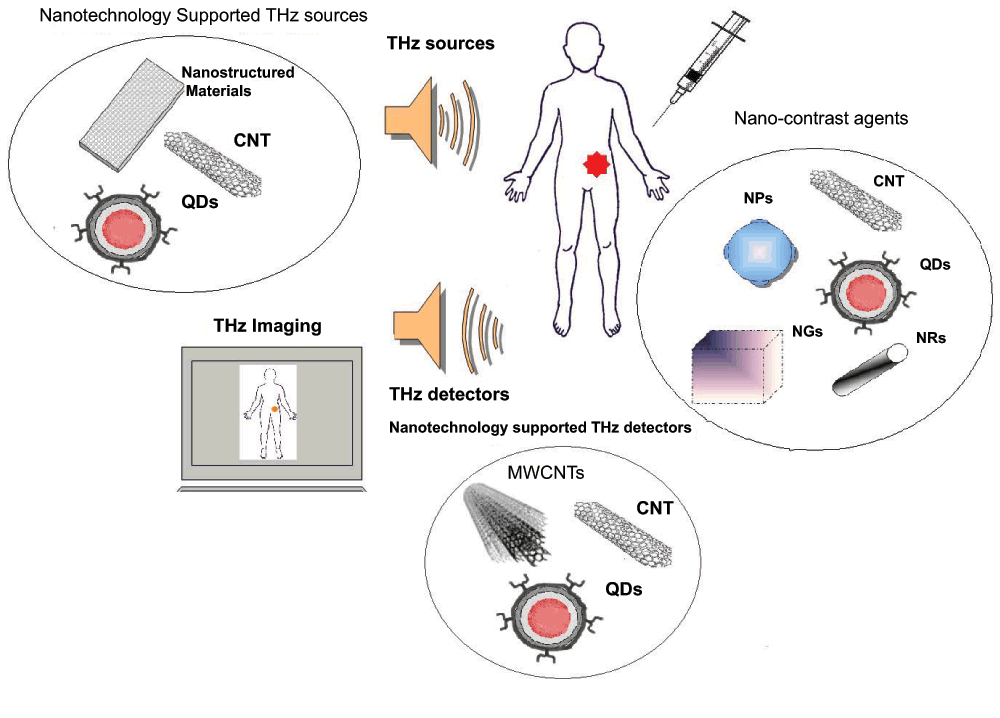

In the past, the frequency spectrum ranging from 0.3 to 3THz (or 300 to 3000GHz) was spoken as infamous “Terahertz Gap” as it lies between traditional microwave and infrared domains but remained “untouchable” via either electronic or photonic means. The conventional “transit-time-limited” electronic devices can hardly operate even at its lowest frequency; the “band-gap-limited” photonic devices on the other hand can only operate beyond its highest frequency. However continuous progress is being made for Terahertz components and devices to overcome electronic/photonic barriers for realizing highly integrated Terahertz systems.
Terahertz can provide hundredfold, increase in the frequency compared to the mmWave addressing spectrum scarcity and capacity limitation in current wireless systems. Terahertz wi-fi could in theory support data rates up to 100Gb/s within ranges of about 10m. THz ad hoc network can be formed in the battlefield to connect soldiers, armoured personnel carriers, tanks, etc. The limited transmission range and highly directional antennas makes eavesdropping extremely difficult.
“Imaging, radar, spectroscopy, and communications systems that operate in the millimeter-wave (MMW) and sub-MMW bands of the electromagnetic spectrum have been difficult to develop because of technical challenges associated with generating, detecting, processing and radiating the high-frequency signals associated with these wavelengths. To control and manipulate radiation in this especially challenging portion of the RF spectrum, new electronic devices must be developed that can operate at frequencies above one Terahertz (THz), or one trillion cycles per second,” says DARPA.
Nanotechnology is key to the 21st Century, involving all aspects of nanoscale science and technology and generating a paradigm shift in diverse areas of physics, chemistry, electronics, materials, engineering, and even medicine and biology, as a result of its interdisciplinary nature. Terahertz electronics are among the fastest growing areas as a result of the discovery, fabrication, and investigation of nanomaterials, in particular carbon nanotubes, graphenes, and compound semiconductors. These advances in nanotechnology have led to the development of nano RF or terahertz devices, which are capable of transcending conventional devices in their compactness, efficiency, performance, and operating frequency.
Terahertz has many applications that require very sensitive technologies such as metal detection, quality assurance, medical spectroscopy, integrity checks, breath-gas analysis, temperature sensing, and biosensing Much progress has been made with terahertz and infrared sensors, each of which employ physical effects — thermoelectrics in semiconductors and plasmonics in noble metals such as gold and silver. Performance is limited by unfavorable physical properties of the sensor materials, and cost and scalability remain challenging. Graphene, however, excels in both of these physical effects. Current technologies would benefit from combination with graphene, making the outlook of creating a highly scalable and cost-effective device very promising
Carbon nanotubes (CNTs) are beginning to take the electronics world by storm, and now their use in terahertz (THz) technologies has taken a big step forward. Researchers have developed flexible terahertz imagers based on chemically ‘tunable’ carbon nanotube materials. The findings expand the scope of terahertz applications to include wrap-around, wearable technologies as well as large-area photonic devices.
Researchers consider CNTs antennas technology will be great success in wireless communication technology This assumption was presented, based on the idea that CNTs can radiate as a small nano-dipole antenna when it is electromagnetically excited. With nanometer length of CNTs dipole antenna, the electromagnetic (EM) radiation from this antenna is expected to cover a range within terahertz and optical frequency