

Nanomaterials are chemical substances or materials that are manufactured and used at a very small scale. Nanomaterial is defined as a, ‘material with any external dimension in the nanoscale (size range from approximately 1 – 100 nm) or having internal structure or surface structure in the nanoscale’. Nanomaterials are developed to exhibit novel characteristics compared to the same material without nanoscale features, such as increased strength, chemical reactivity or conductivity.
Nanostructures have the capacity to disrupt a number of industries and they can revolutionize material science, medicine and battery technology to name just a few. If we can truly harness nanomaterials then almost every facet of modern life will change, from the clothes we wear to our water filtration system. It’s one of those breakthroughs that really could change everything. So the potential is immense, but nanostructures are complex to produce in usable form. Scaling them up to a workable size has caused issues with the structural integrity, performance and consistency.
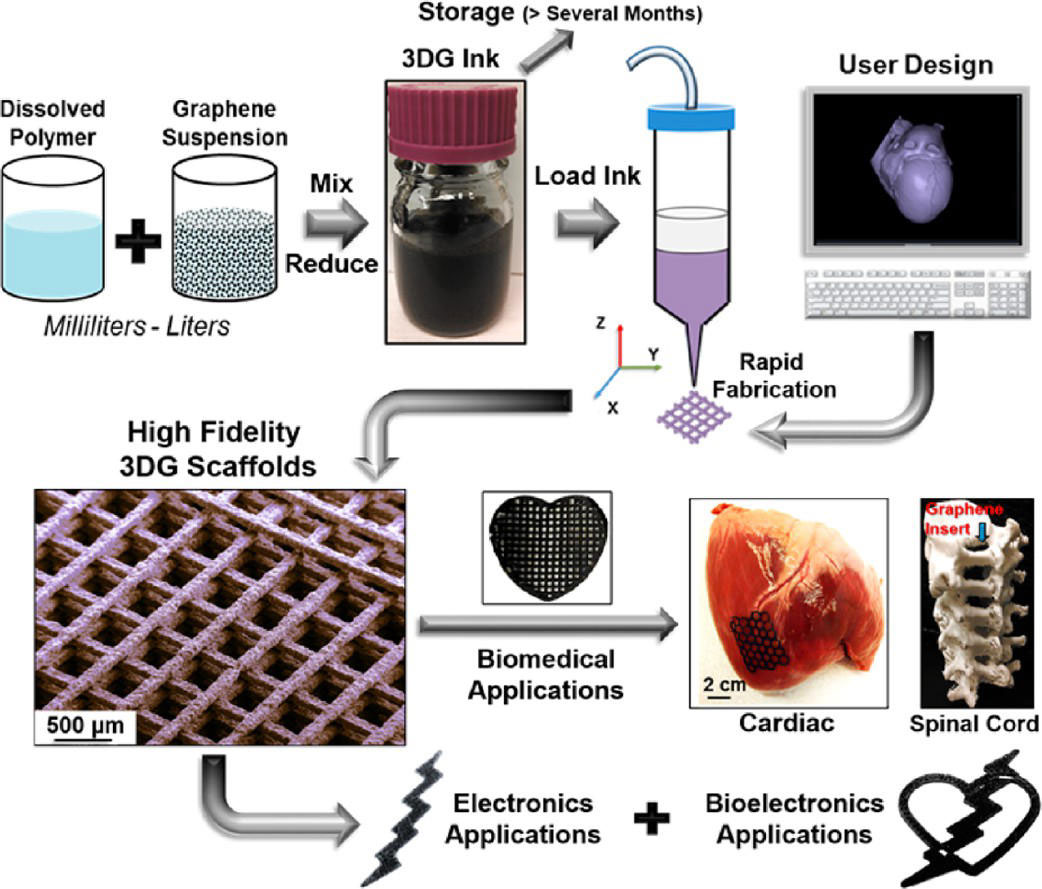
Three-dimensional (3D) nanoprinting, a class of nanoscale additive manufacturing techniques, is attracting increasing interest because it offers novel possibilities for designing and fabricating nanoscale components and devices. Additive manufacturing is a way of making 3-D objects by building up material, layer upon layer, with the guidance of a digital design. The processes are engineered to use material more efficiently, give designs more flexibility and produce objects more precisely. Above all, they make things quickly. Applying 3D printing concepts to nanotechnology could bring similar advantages to nanofabrication – speed, less waste, economic viability – than it is expected to bring to manufacturing technologies.
Metamaterials extend the capabilities of conventional materials in devices by making use of geometric features arranged in repeating patterns at scales smaller than the wavelengths of energy being detected or influenced. New developments in 3-D printing technology are making it possible to create many more shapes and patterns of metamaterials, and at ever smaller scales. In the study, researchers at the Nano Lab at Tufts describe a hybrid fabrication approach using 3-D printing, metal coating and etching to create metamaterials with complex geometries and novel functionalities for wavelengths in the microwave range.
There are wide ranging applications of 3D printed nanotechnology, In 2013, American researchers managed to 3D print extra efficient batteries the size of a grain of sand, by using ink containing Lithium ion nanoparticles! It’s easy to imagine such batteries being used in nanoelectronics, like very small cameras. Another application is in filtration systems: with Nanoscribe’s machine it is possible to create nanofluidic filters inside channels that are only a micrometer wide. In the future using Printable electronics we shall be able to develop 3D printing flexible screens or flexible batteries, that are so thin they can be rolled up and fit in a pocket!
Researchers have produced many 3D printers capable of fabricating nanomaterials. Materials scientists based at the Massachusetts Institute of Technology new approach for the 3D printing of nanofiber meshes. Nanofibers being produced on a large scale and of good quality, with little variation with the diameters of the fibers produced. Diameter control is important since the performance of the fibers dependent upon their diameter.
Jan Torgersen created a 3D printer which is able to produce nano-scaled objects suitable for numerous applications in photonics, surface modifications and biomedical engineering. It’s currently the fastest of its kind and brings the technology closer to industrial applications. The company Nanoscribe applies stereolithography to the nanoscopic world. With their Photonic Professional GT machine, they can create objects as small as only a few microns.
DARPA is looking for combat 3D printers which can print ultra-strong materials based on nanomaterials that small infantry units can use for a variety of tasks in urban combat, such as erecting obstacles, fortifications and camouflage.