

Quantum computing is expected to increase significantly the computational speed since it operates on completely different principles in comparison to classical computers. In addition, it was predicted that quantum computers can increase the computational speed of at least some problems. For instance, a sub-exponential speed-up is expected if the quantum Shor algorithm is applied to the problem of finding the prime factors of an integer number, the quantum Grover algorithm quadratically increases the speed of searching for an item in an unordered list, and an exponential speed-up is foreseen for simulating the dynamics of quantum systems by quantum computers.
Normal digital computers operate on the basis of a binary code composed of bits with a value of either 0 or 1. In quantum computers, the bits are replaced by qubits, which can be in two states simultaneously, with arbitrary superposition. This significantly boosts their calculation and storage capacity for certain classes of applications. But making qubits is no mean feat: quantum phenomena require highly controlled conditions, including very low temperatures.
On the other hand, quantum computing systems are very sensitive to the environment, and therefore can only be implemented in small physical systems, with only few degrees of freedom, in which the energy difference between the quantized states are larger than the thermal energy.
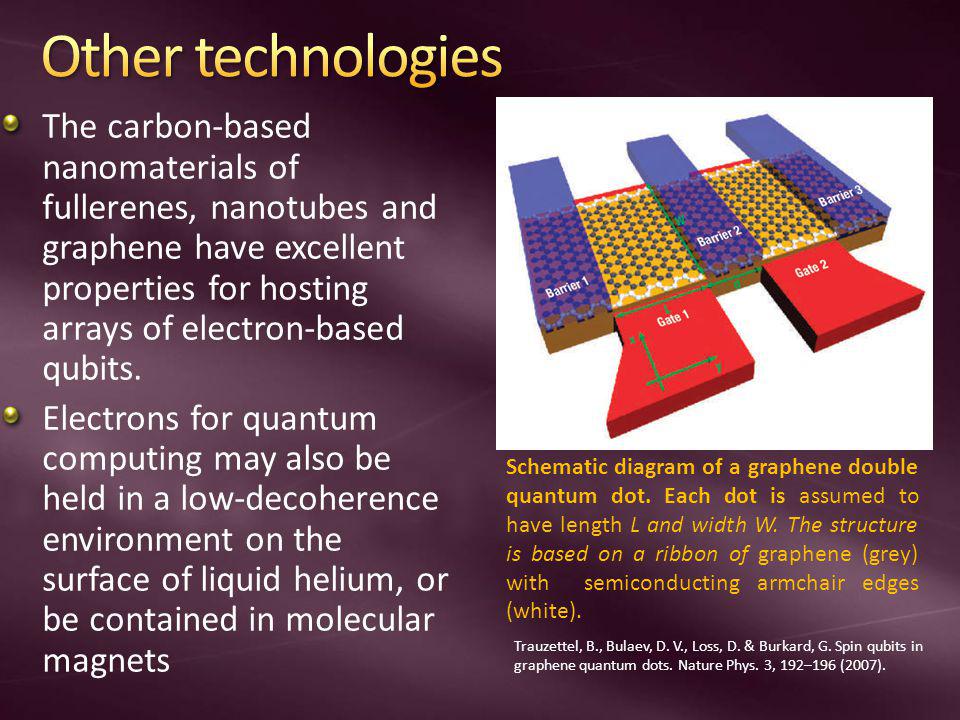
In the race to produce a quantum computer, a number of projects are seeking a way to create quantum bits – or qubits – that are stable, meaning they are not much affected by changes in their environment. This normally needs highly nonlinear non-dissipative elements capable of functioning at very low temperatures. Quantum computing can be implemented in small, nano-sized systems, such as trapped atom or ions, spin states, superconductors or conductors in the ballistic transport regime. Graphene is a suitable material for implementing quantum logic gates due to its large room-temperature mean free path.
Graphene is a 1-atom-thick layer of tightly bonded carbon atoms arranged in a hexagonal lattice. Graphene the world’s first 2D nanomaterial, is widely regarded as the “wonder material” of the 21st century due to the combination of its extraordinary properties. As a single layer of graphite, it is the thinnest material (monoatom thick), transparent, 200 times stronger than steel, yet as flexible as rubber, more conductive than copper, excellent thermal conductor and impermeable to moisture and gases. Graphene is also extraordinarily light at 0.77 mg/m2, which is roughly 1,000 times lighter than 1 m2 of paper. It is fire resistant yet retains heat.