

Sometimes long runways required by conventional aircrafts aren’t available to use or there is a need for an aircraft to use no runways at all. Vertical take-off and landing VTOL technology means aircraft can theoretically take off and land almost anywhere, making them far more flexible. They’re also able to perform various manoeuvres not possible with a conventional plane; a significant advantage for aircraft in combat situations. What’s more, VTOL aircraft, such as drones, that use electric motors are more energy efficient than those using jet engines.
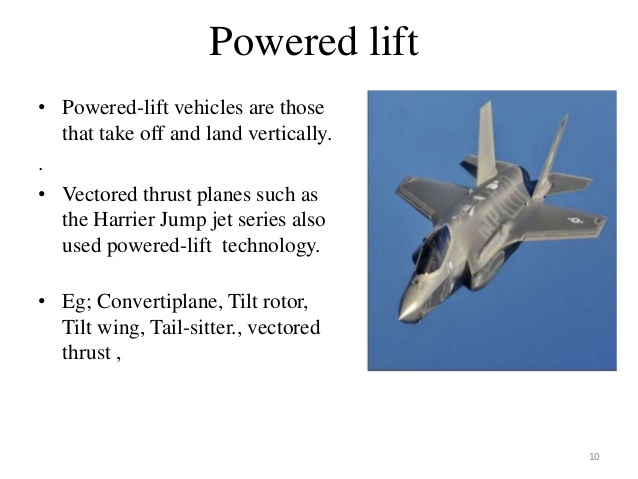
VTOL technology is increasingly making its way into more aircraft, from small recreational drones up to the traditional systems in helicopters and military jets. One of the best knows V/STOL capable aircraft are: Harrier Jump Jet, Bell-Boeing V-22 Osprey, AW609, F-35B. Bell V-280 Valor, Yak 141, XFY-1 Pogo and Fairey Rotodyne. The F-35B Standard Take-off and Vertical Landing (STOVL) is a single-engine, fifth generation fighter aircraft designed and developed by Lockheed Martin. It is the first aircraft to combine stealth technology with STOVL capabilities and supersonic speeds. The tricycle type retractable undercarriage design allows the aircraft to take-off from and land on the deck of small naval ships, unimproved airstrips, rough airfields and roads.
NASA has developed the battery-powered GL-10, which take off and land vertically but flies efficiently like a conventional plane. The current prototype is a two-seater aircraft shaped like a conventional plane that uses a VTOL system.
Aurora Flight Sciences, a subsidiary of aerospace giant Boeing, said in Jan 2019 that it recently conducted the first test flight of its all-electric autonomous passenger air vehicle. The unpiloted vehicle took off vertically, hovered for a few seconds, and then landed at the company’s test site in Manassas, Virginia. Boeing said that future flights will test forward, wing-borne flight, as well as the transition phase between vertical and forward-flight modes.
Powered by an electric propulsion system, Boeing says the prototype is designed for fully autonomous flight from takeoff to landing, with a range of up to 50 miles (80.47 kilometers). Measuring 30 feet (9.14 meters) long and 28 feet (8.53 meters) wide, its airframe integrates the propulsion and wing systems to achieve efficient hover and forward flight (also known as vertical takeoff and landing, or VTOL). It’s a significant step toward a future in which autonomous, electric “flying taxis” zip from skyscraper to skyscraper, bearing passengers and cargo in service of an entirely new form of urban mobility.