
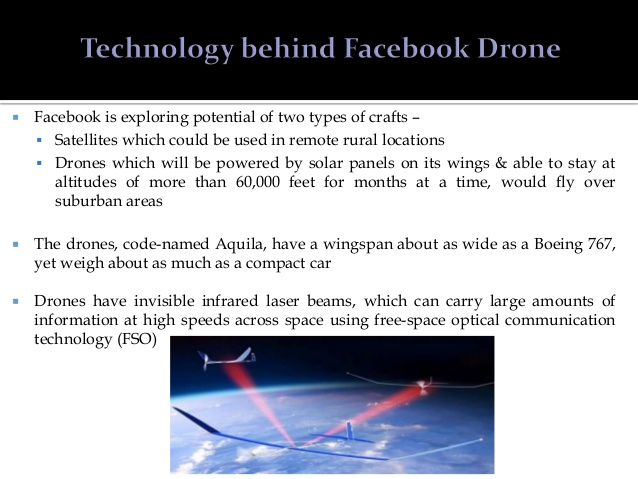

Aerospace companies including Facebook, Boeing and Google have been trying for years to create a solar-powered plane that can fly at high altitudes for years at a time, and can provide broadband communication services. They could have many uses, for example acting as a relay station for communications in emergencies such as natural disasters that have knocked out ground-based telephones and internet links. Civil applications could include pipeline, crop and forestry fire monitoring, fisheries protection and border control. Military is also turning to solar powered stratospheric drones for communications and persistent, wide area, real time Intelligence, Surveillance, and Reconnaissance (ISR).
Near space has long been seen as a promising frontier for intelligence services, but has remained relatively untapped because it is too high for most aeroplanes to operate, and too low for satellites. Until now, the Northrop Grumman RQ-4 Global Hawk, limited to an altitude of about 19km, has been the highest flying drone in use, but it can only stay aloft for 32 hours at a time. The RQ-4 Global Hawk provided outstanding surveillance and reconnaissance in Afghanistan and Iraq, though the number of aircraft was insufficient to provide 24/7 coverage.
High-altitude communications platforms “such as Aquila and Titan Aerospace show tremendous promise,” Richard Whitt, director of Google’s strategic initiatives, and Yael Maguire, head of Facebook’s Connectivity Lab, wrote in a joint blog post. “Over 30 percent of the world lives beyond the range of mobile broadband. In rural areas, in which approximately half the world lives, that number is over 70 percent,” Whitt and Maguire wrote. “Recent improvements in composite materials, low-power computing, battery technology and solar panels have made (platforms such as Titan and Aquila) a new way to spur the growth of rural wireless networks.”