
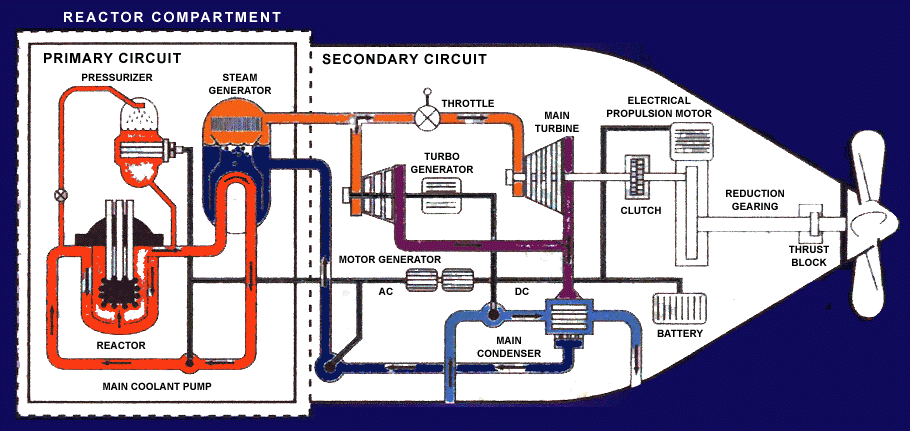

A nuclear submarine is a submarine powered by a nuclear reactor. The performance advantages of nuclear submarines over “conventional” (typically diesel-electric) submarines are considerable. Nuclear submarines are more powerful than diesel-powered submarines because nuclear reactors powering them can run for years without the need for refuelling. Nuclear propulsion, being completely independent of air, frees the submarine from the need to surface frequently as is necessary for conventional submarines and thus enhance their survivability .
The large amount of power generated by a nuclear reactor allows nuclear submarines to operate at high speed for long periods of time; and the long interval between refuelings grants a range virtually unlimited, making the only limits on voyage times being imposed by such factors as the need to restock food or other consumables. Nuclear submarines are considered nemesis of Aircraft carriers, over the course of World War II; no less than seventeen aircraft carriers were sunk by submarines including seventeen were put down by U.S. submarines.
Unlike conventional submarines, nuclear submarines have greater mobility and autonomy and are essential for patrol operations in remote ocean areas. While conventional submarines move at a speed of six knots (about 11 kilometer per hour), nuclear-powered submarines can reach 35 knots—about 65 km per hour.
The development in the nuclear sectors has enabled a lot of countries to build nuclear-powered submarines to defend their borders. The high cost of nuclear technology means that relatively few states have fielded nuclear submarines. Some of the countries with nuclear submarines are the United Kingdom, Russia, India, United States, China, and France. The U.S. Navy has 70, Russia has 41 including the ill-fated deep-diving special submarine Losharik, on which 14 submariners lost their lives in July 2019. China is next with 19; Britain has 10; France, nine; and India, three.
Other countries such as Brazil and South Korea are also joining the club. Brazil’s nuclear submarine program leverages French design help, but with a local reactor. The initial boat, Álvaro Alberto, was laid down in 2018 and should be ready to join the fleet by 2029. South Korea’s intention was only revealed when it announced on October 2019 that they are considering it. In January 2018 Tehran informed the U.N.’s nuclear watchdog, the International Atomic Energy Agency (IAEA), that it intends to “construct naval nuclear propulsion in the future.” Iran does have a local submarine building industry and has launched a series of successively larger submarines.
Modern submarine fleet is made up of three major types of boats: ballistic-missile submarines, attack submarines, and cruise-missile submarines, each of which serves a specific purpose. The nuclear ballistic submarines are equipped with nuclear weapons capable of delivering a retaliatory or preemptive strike almost anywhere in the world. Attack submarines take care of tactical missions like intelligence gathering, launching cruise missiles, and even sinking ships or submarines. Because attack submarines carry cruise missiles, they constitute a navy’s most crucial and versatile weapon in any frontal assault. Cruise missiles are designed to deliver a large warhead over long distances with high accuracy, and they are intended to hit both land and sea targets. Combined, these two types of submarines make up the preponderance of what will likely be the future of undersea warfare.
The world’s three largest naval powers are all developing the next generation of their nuclear submarine fleets, accelerating the underwater arms race between the United States, China and Russia.