

U.S. military researchers are asking industry to develop relatively simple portable photonic integrated circuits (PICs) for high-performance position, navigation, and timing (PNT) devices as an alternative to the Global Positioning System (GPS) for when GPS signals are not available.
Position, Navigation, and Timing (PNT) is a critical resource for all Department of Defense (DoD) missions, affecting areas such as communications, navigation, reconnaissance, and electronic warfare (EW). Typically, PNT needs are met using the Global Positioning System (GPS).
However, GPS signals are vulnerable to a variety of disruption methodologies, and a backup to GPS is essential. Although in the absence of GPS, tactical-grade clocks and tactical-/navigation-grade Inertial Measurement Units (IMUs) can currently provide GPS-like accuracy for the short term, longer-term, GPS-independent strategies are required.
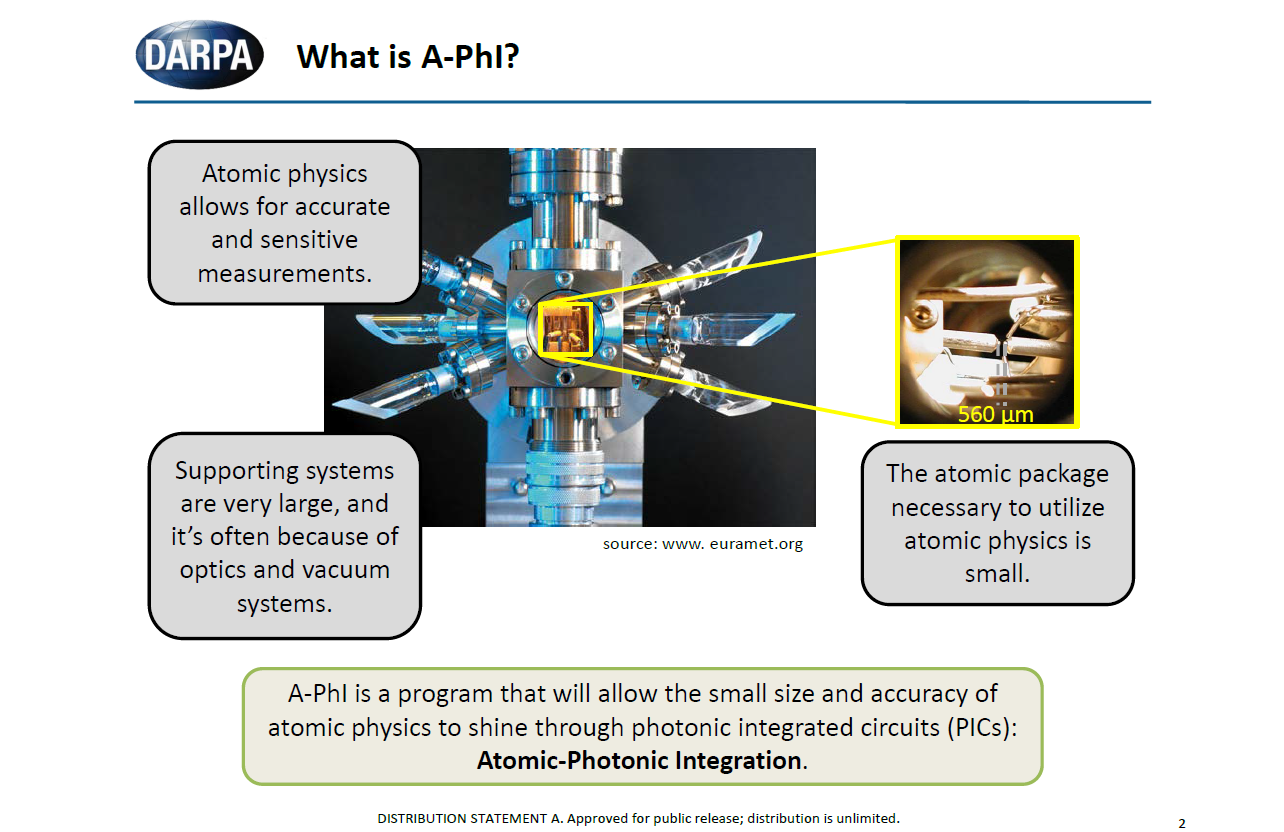
Atomic systems are the basis for the most sensitive and accurate angle sensors and clocks demonstrated. Large, lab-based atomic physics clocks and gyroscopes are the only technology known that deliver GPS-like timing and navigation for more extended time scales. Among these atomic systems, those that use trapped atoms have the potential to be made portable while maintaining their accuracy due to the small size of the atomic trap and the inherent isolation of the atomic system from environmental disturbances provided by the trap.
However, these trapped atom systems are currently large due to their optical system’s complexity. Historical approaches to miniaturization of their hundreds to thousands of optical components has relied on removing optical elements, miniaturizing the remaining elements, and then tightly integrating them in a small package. Although this has led to more compact atomic clocks and gyroscopes, the resulting system suffers from degraded performance and a heavy reliance on maintaining very tight optical alignment which causes poor environmental robustness and tolerance to design errors. This approach also makes them difficult to manufacture at a reasonable cost.
The objective of the A-PhI program is to reduce the complexity of trapped atom-based high performance Position, Navigation, and Timing (PNT) devices using photonic integrated circuits (PIC). A-PhI aims to demonstrate that compact PICs can replace the optical bench of conventional free space optics for high-performance trapped-atom gyroscopes and trapped-atom clocks without degrading the performance of the underlying physics package.
PICs have been the subject of many recent developments, demonstrating that they can replace optical systems with readily-manufacturable and low-cost chips that have none of the alignment sensitivity of conventional free-space optics. Such examples include on-chip optical frequency combs based on microresonators, optical frequency synthesis, novel and efficient on-/off- chip coupling, wavelength demultiplexers, and on-chip phased arrays for dynamic manipulation of light fields.
DARPA seeks innovative proposals for: 1) the development of portable Photonic Integrated Circuits (PICs) to reduce the complexity of trapped atom-based high-performance Position, Navigation, and Timing (PNT) devices; and 2) proving the feasibility and advancing the development of a trapped-atom gyroscope: a matter-wave analogue of the interferometric fiber-optic gyroscope.
“If we want to have navigation and timing capabilities at a device level rather than from a satellite [from GPS], what are the things we need to do? You need timing: GPS gives you timing information, so that is one technical area,” he said. “The other technical area: a gyroscope, which goes to IMU [inertial measurement unit], would be a device-level navigation device, said John Burke, the DARPA programme manager for A-PhI.” “The capabilities that we could get out of these things would be the most beneficial in the shortest amount of time,” Burke said.