

Since the creation of the main battle tank during World War I, there has been a constant arms race between the development of anti-armor weapons and vehicle protection systems, however “Weapons’ ability to penetrate armor, however, has advanced faster than armor’s ability to withstand penetration”.
The traditional protection technique depends on the amount of armor, has reached a practical limit for today’s threat environments, as main battle tanks and infantry fighting vehicles have reached weights approaching 70 tons. The trend of increasingly heavy less mobile and more expensive combat platforms has limited Soldiers’ ability to rapidly deploy and maneuver in theater and accomplish their missions in varied and evolving threat environments. Moreover, larger vehicles are limited to roads and bridges they are able to travel on, require more logistical support and are more expensive to design, develop, field and replace.
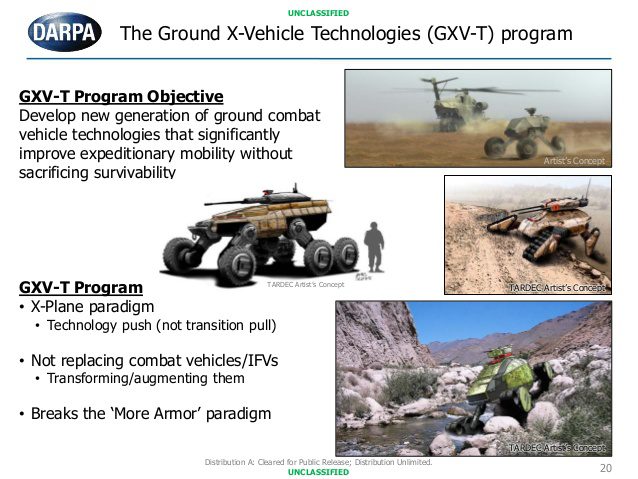
DARPA launched Ground X-Vehicle Technologies (GXV-T) program aims to improve mobility, survivability, safety, and effectiveness of future combat vehicles without piling on armor. Several Phase 2 contract awardees recently demonstrated advances on a variety of potentially groundbreaking technologies to meet the program’s goals.
“We’re looking at how to enhance survivability by buttoning up the cockpit and augmenting the crew through driver-assistance aids,” said Maj. Amber Walker, the program manager for GXV-T in DARPA’s Tactical Technology Office. “For mobility, we’ve taken a radically different approach by avoiding armor and developing options to move quickly and be agile over all terrain.”
The Ground X-Vehicle Technologies (GXV-T) Program is largely complete, and it’s archived on DARPA’s website. Most of the tech has proven itself in the lab and testing, but now some will—and some won’t—get deployed to units over the next few years.