
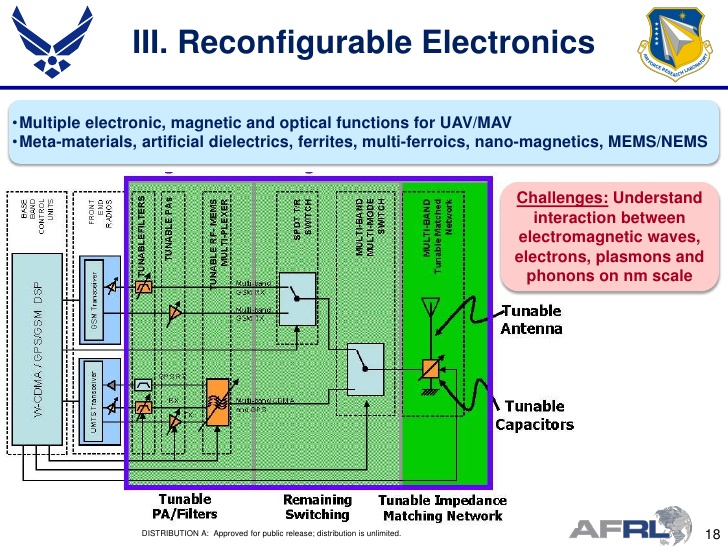

Traditionally, electronics have been designed with static form factors to serve designated purposes. This approach has been an optimal direction for maintaining the overall device performance and reliability for targeted applications. As the world enters the age of ubiquitous computing, the need for reconfigurable hardware operating close to the fundamental limits of energy consumption becomes increasingly pressing. Militaries are demanding technologies that could enable reconfigurable multi-function systems able to switch quickly between radar, electronic warfare (EW), signals intelligence (SIGINT), and communications. This kind of equipment has the potential to adapt to different conditions and operating modes to change rapidly depending on pressing military mission needs and threats.
Reconfigurable electronics might use reprogrammable RF and microwave components and signal-processing components such as field-programmable gate arrays that can change their modes and capabilities quickly. Other technologies could involve new software algorithms able to learn how to collect the most valuable information autonomously. Another technique is to use new materials with built in reconfigurality.
Reconfigurability refers to specific features that can be changed (to include dynamic and partial reconfigurability), whereas adaptiveness addresses the behavioral constructs that inform how reconfigurable features might best be exploited in live use conditions. They can have synergistic effects, as in a system that might be able to morph in response to changing conditions (such as battery saving, reduced bandwidth, noisy communications channels) by altering a few of its own ‘‘knobs’’ or, more radically, by reshaping and replacing complex circuits in real time, says IEEE.
Adaptable electronics is generating significant interest in the scientific community because of the many applications. Imagine for a moment that one single microchip was capable of accomplishing the tasks of several different circuits. For example, a circuit assigned to process sound information could, when not being used for this purpose, be reassigned to process images. This would allow us to miniaturise our electronic devices.
At the same time, it would become possible to develop resilient circuits. Whenever a microchip is damaged, it could theoretically reconfigure itself so that it could still function using the components that remain intact. “An effective way to keep faulty devices working when they are in hard-to-reach places, like space,” says Leo McGilly, the article’s lead author.
Adaptive reconfiguration can also be used as a technique to expand the operational envelope of analog electronics for extreme environments (EE). Conventional circuit design exploits device characteristics within a certain temperature/radiation range; when that is exceeded, the circuit function deviates from its set-point. On a reconfigurable device, although component parameters change in EE, a new circuit design suitable for new parameter values may be mapped into the reconfigurable structure to recover the initial circuit function. Partly degraded resources can still be used, while completely damaged resources may be bypassed.
Laboratory demonstrations of this hardening-by-reconfiguration technique were performed by JPL in several independent experiments in which bulk CMOS reconfigurable devices were exposed to, and functionally altered by, low temperatures (~ −196°C), high temperatures (~280°C) or radiation (300kRad TID), and then recovered by adaptive reconfiguration using evolutionary search algorithms.
If electronic circuits could automatically reconfigure their internal conductive pathways as required, microchips could function as many different circuits on the one device. If many of these devices were then incorporated into larger pieces of equipment, such as robots, it is possible that self-sufficient, self-sustaining machines could change to suit their environment or even reconfigure broken or damaged pathways to repair themselves.