

Quantum encryption using single photons is a promising technique for boosting the security of communication systems and data networks, but there are challenges in applying the method over large distances due to transmission losses. Currently Most Quantum Communication links are direct point-to-point links through telecom optical fibers and, ultimately limited to about 300-500 km due to losses in the fiber. Experimentally, QKD has been implemented via optical means, achieving key rates of 1.26 megabits per second over 50 kilometres of standard optical fibre and of 1.16 bits per hour over 404 kilometres of ultralow-loss fibre in a measurement-device-independent configuration.
Quantum internet—the quantum version of the current Internet—holds promise for accomplishing quantum teleportation, quantum key distribution (QKD) and precise synchronisation of atomic clocks among arbitrary clients all over the globe, as well as longer-baseline telescopes and possibly even simulation of quantum many-body systems. Developing the quantum network relies on two technologies, one is use of quantum satellite which can connect over large distances, China has already launched a quantum satellite.
Another method is to use optical amplifiers just as amplifiers are used to regenerate the signal in classical communication. Along the way, the signal passes through repeaters, where it is read, amplified and corrected for errors. Similar to its classical analogue, a quantum repeater is a device that can extend the range of quantum communication between sender and receiver. In contrast to classical network, however, quantum information cannot be detected or amplified without having its information converted back to classical information. Straightforward adoption of an optical amplifier in a quantum network therefore cannot work.
The whole process is at any point vulnerable to attacks. Secondly to realise it in a global scale for arbitrary users, it is reasonable to utilise also existing optical networks that have already been installed in the world. An indispensable building block for implementing such a quantum internet against photon loss of optical fibres is to use quantum repeaters over an optical network, irrespective of its topology. However, in the quantum regime this adds too much noise and destroys the coherence of the quantum states.
In China, extensive quantum networks have already been built use simple “trusted nodes” that measure and retransmit information about quantum states. But quantum repeaters at the present time are a long way from becoming standardized commercial products. NTT/NIST has utilized teleportation technique could be used make quantum repeaters. One significant limitation with current quantum repeater technology is that while it facilitates secure transactions through QKD, it may not itself be secure. “Quantum” repeaters today are actually hybrid systems and include classical computing devices that – as the Japanese scientists point out – are just as vulnerable as other classical systems to security violations. It is true that a quantum repeater can be physically secured, but quantum encryption based on repeaters that are not themselves secure, detracts from the business case for QKD and could also be a problem for those sharing of quantum computer resources over a cloud and/or a network.
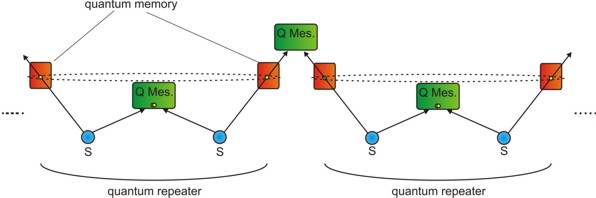
How can you amplify and correct a signal if you can’t read it? The solution to this seemingly impossible task involves a so-called quantum repeater. Unlike classical repeaters, which amplify a signal through an existing network, quantum repeaters create a network of entangled particles through which a message can be transmitted. A quantum repeater has to achieve an effective “amplification” or restoration of the quantum information without resorting to a direct measurement of the laser light. The key technology for implementing quantum repeaters is quantum memories that allow the storage of quantum states.
If this stage in the evolution of the quantum repeater actually occurs, it will probably be a device that does not have extensive integrated memory requirements. At the present time, we are at a stage in quantum repeater development where storage is largely classical, raising the vulnerability issues mentioned above. The next stage will be quantum repeaters utilizing quantum memories. But NTT for one is researching quantum repeaters without quantum memories, says CIR report. Its optical quantum repeater, designed with some Canadian researchers, appears to eliminate the quantum memories in repeaters.