
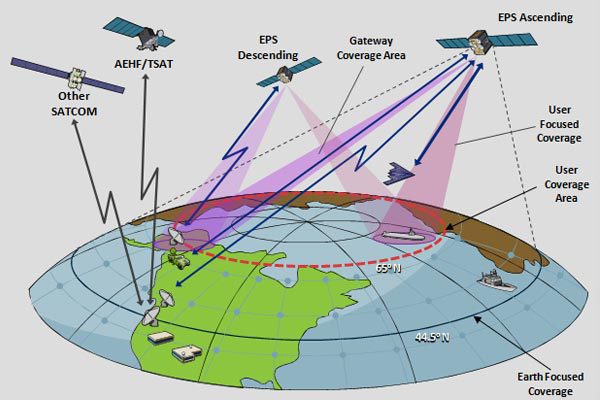

US DOD’s Advanced Extremely High Frequency Satellite (AEHF) is a joint service satellite communications system that provides global, survivable, secure, protected, and jam-resistant communications for high priority military ground, sea, and air assets. The AEHF system provides joint, interoperable, assured connectivity for warfighters in operations in all levels of conflict–a capability not available through other planned military communication networks.
US DOD has lunched AEHF Series of satellites consisting of six satellites in geostationary orbits, three of which have been launched. When complete, the space segment will provide coverage of the surface of the Earth between latitudes of 65 degrees north and 65 degrees south. The Enhanced Polar System (EPS) represents an evolution of requirements for protected extremely high frequency (EHF) satellite communications in the North Polar Region; above 65 deg N. EPS is the next-generation SATCOM system that will replace the current Interim Polar System (IPS) and serve as a polar adjunct to the Advanced EHF system.
As the Global warming is melting the Arctic ice, and opening up new shipping trade routes and real estate, intense resource competition over an estimated $1 trillion untapped reserves of oil, natural gas and minerals has started. Russia is acting quickly to become dominating Geostrategic and Military power in the Arctic. On May 10, 2013, President Obama issued the National Strategy for the Arctic Region (National Strategy) to articulate strategic priorities to enable the United States to ”respond effectively to challenges and emerging opportunities arising from significant increases in Arctic activity due to the diminishment of sea ice and the emergence of a new Arctic environment.”
US DOD had issued a request for information for the Multi-Service Demonstration for Arctic Challenges project. This initiative, seeks to find technology-demonstration candidates from private industry, government research and development (R&D) organizations, and academia to demonstrate military technologies for Arctic operations. One of the areas identified by RFI calls for is Persistent Command, Control, Communications, Computers, Intelligence, Surveillance, Reconnaissance (C4ISR) capable of supporting domain awareness and information sharing in the Arctic region.
Communications is a big challenge in ArcticCommunications satellites operating in geostationary Earth orbit do not cover the area of the Arctic. Even when a link can be made, it can be prone to interruption from icing on antennas, or from disruption caused by heavy seas. The Iridium satellite constellation can supply communications services in the Arctic, but there have been recorded cases of interruptions to the service which can last several minutes. It also does not provide the broadband communication that will be needed more and more with the development of human activities in the region, posing a challenge for the coming years.
A range of projects, including the ARTES 1 ArctiCOM project, have investigated possible solutions to the Arctic communications problem. Russia also has strong territorial reasons for wanting to improve communications in the Arctic and has proposed the Arktika satellites.