

Developing and delivering air superiority for the highly contested environment in 2030 requires a multi-domain focus on capabilities and capacity, according to the unclassified version of the Air Superiority 2030 Flight Plan. “After 25 years of being the only great power out there, we’re returning to a world of great power competition,” said Lt. Gen. Mike Holmes. “We need to develop coordinated solutions that bring air, space, cyber, the electronic environment and surface capabilities together to solve our problems.”
Implementing multi domain operations require is achieving MDC2. MDC2 can be defined as C2 across all domains that protects, permits and enhances the conduct of operations to create desired effects at the time, place and method of choosing. Recently, the Chief of Staff of the US Air Force published a white paper that describes three characteristics of MDC2: situational awareness, rapid decision-making, and the ability to direct joint forces to achieve Commander’s intent. The technical challenges with operationalizing this concept is that MDC2 systems must have a network that supports the exchange of ‘big data’, removes stove-piped data streams, and improves interoperability.
The communications environment today consists of a multitude of communications systems designed to meet specific and often discrete needs. This has resulted in “stove pipe” systems which have limited interoperability due to system-unique technical, data, security, and interface standards.
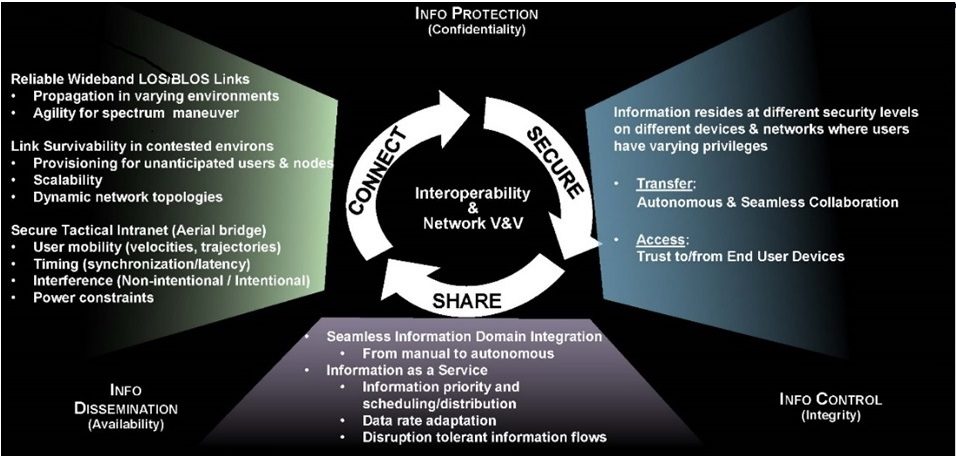
The Air Force Research Laboratory, Information Directorate (AFRL/RI) is seeking information to better understand existing vendor offerings and the landscape of research and development (R&D) on building a seamless multi-domain communications “network of networks” fabric across the Command and Control, Intelligence, Surveillance, and Reconnaissance (C2ISR) enterprise. The goal is not a single network; rather, a “network of networks” paradigm that appears seamless to the user and encompasses various missions, geographic areas, and threat environments.
The ability to communicate has huge impact, it goes beyond allowing users to talk to each other; for the military it enables not just a kill-chain (a linear sequence to find-fix-track-target-engage-assess) but rather a “kill-web” compromised of complex connections between assets facing potential disruptions from many different directions and failure points.
Key to delivering any communication capability is understanding the network information exchange requirements (IERs) of each node (platform) type to support effective mission execution. These IERs, in turn, drive the characteristics incumbent upon the network – i.e. bandwidths, frequencies, latency, information priority to the mission, and how long a node will be present on the network; i.e. dedicated versus opportunistic.