

Advanced sensors and actuators, together with exponential improvements in computer technology, are causing a surge of interest in the development of “intelligent” structures and equipment. A smart structure consists of four key elements: actuators, sensors, control strategies, and power conditioning electronics. Numerous applications include automotive springs, smart skins on aircraft, smart bridges, improved biomedical devices, and advanced military systems. The shorter-range interests address incorporation of sensors into systems that monitor structural performance throughout the life cycle. The long-range goal is the deployment of active systems that are able to autonomously adapt in response to a change in the environment. These technologies offer the potential of substantive advancements for better, more reliable structures.
For developing smart structures, Many types of actuators and sensors such as piezoelectric materials, shape memory alloys (SMA) (alloys that can remember their original shapes), electrostrictive and magnetostrictive materials, and fiber optics are being considered for various applications. Scientists and engineers are investigating materials systems that are capable of monitoring condition, changing shape, controlling vibrations, accommodating changes in the environment. Smart materials or Active materials or Functional materials are designed materials that have diverse, dynamic features that enable them to adapt to the environment. They have one or more properties that can be significantly changed in a controlled fashion by external stimuli, the stimulus and response may be mechanical, electrical, magnetic, optical, thermal, or chemical.
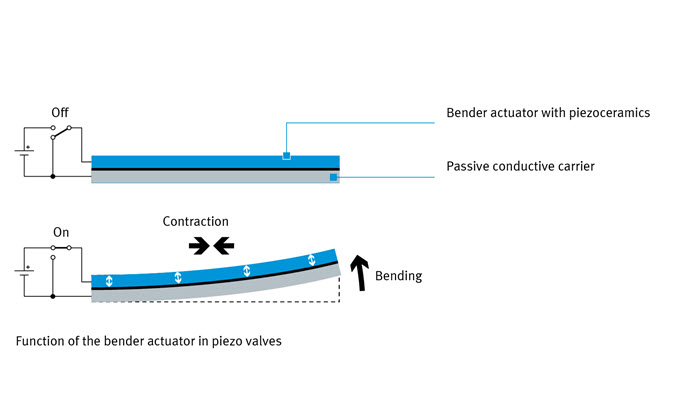
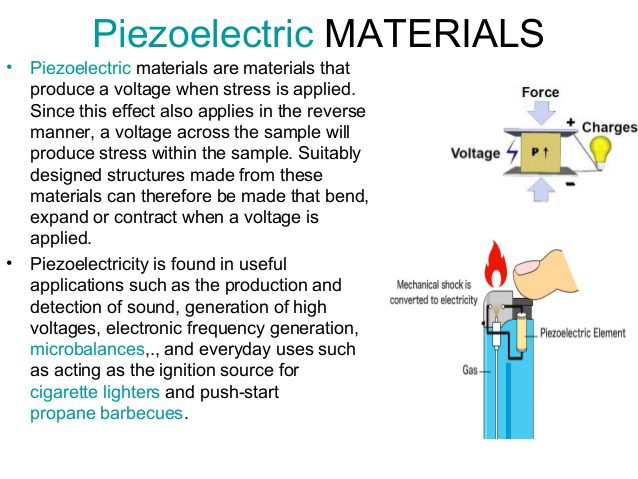
One of the class of smart material is Piezoelectric materials. In a piezoelectric material, the application of a force or stress results in the development of a charge in the material. Conversely, the application of a charge to the same material will result in a change in mechanical dimensions or strain.These are materials that produce a voltage when stress is applied. Since this effect also applies in the reverse manner, a voltage across the sample will produce stress within the sample. Suitably designed structures made from these materials can therefore be made that bend, expand or contract when a voltage is applied.
Piezoelectric crystals, like quartz have been long used in devices like watches and medical instruments. These materials provide the ability convert electrical energy into mechanical energy in the form of tiny deformations in the material. The piezoelectric effect, have been extensively utilized to demonstrate various devices, such as transducers, sensors, actuators, surface acoustic wave (SAW) devices, frequency control, etc. Piezoelectric materials are being used for contact sensors for alarm systems and in microphones and headphones. Piezoelectric materials are widely used in sensors and help in measuring fluid density, the force of impact, and fluid composition.
The demand of Piezoelectric Devices is being driven by factors such as arrival of smartphone, internet boom and IoT. They are also enabling technologies that help in generating energy using different sources. The technologies that can convert body movement into electric energy that can charge mobile phone, power streetlights, etc. are expected make considerable headways in the future.