

Finding new materials has traditionally been guided by intuition and trial and error,” said Turab Lookman, a physicist and materials scientist in the Physics of Condensed Matter and Complex Systems group at Los Alamos National Laboratory. “But with increasing chemical complexity, the combination possibilities become too large for trial-and-error approaches to be practical.”
Computational and theoretical materials science is playing an increasingly important role in advancing the search for novel materials and understanding the properties of existing ones. Computational research uses complex models in a variety of ways, all of which advance materials science and engineering. Modern computational hardware and software enable faculty to create “virtual laboratories,” where materials are tested and properties predicted computationally. “Problems that used to take years to solve can now be solved in a month,” says Srikanth Patala, a materials science and engineering researcher at NC State.
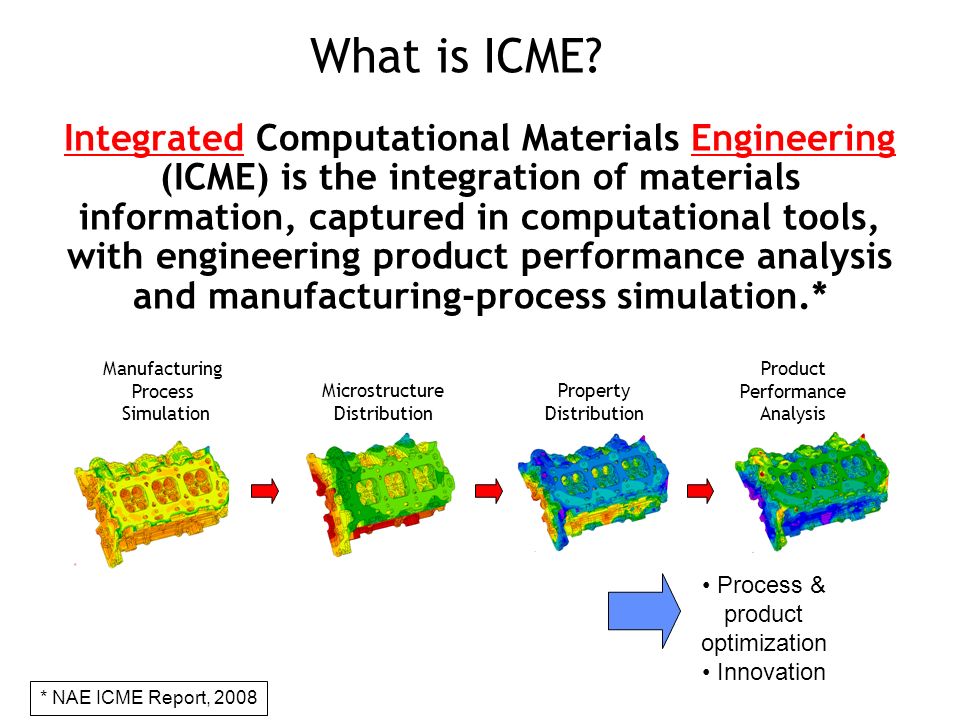
Integrated Computational Materials Engineering (ICME) is an emerging discipline which seeks to accelerate the development of new materials by linking materials models of the manufacturing process to the composition and structure and hence properties of the material, enabling the rapid design and development of materials for specific applications at low cost. ICME can rapidly focus the search for new, optimised materials in the most promising regions of multidimensional materials space and provide decision support to reduce empiricism. While ICME requires a fundamental understanding of materials structure, properties and performance, the aim is to develop a comprehensive computational model to simulate the design and manufacture of new materials and products.
“These computational models can help researchers understand the outcome of an experiment, identify the most promising avenues for future experiments, and give us insight into processes that can’t be easily explored in the lab,” says NC State researcher Don Brenner, a pioneer in the field of computational materials research who has been publishing in the field since the late 1980s. “For example, computational research helps us understand the behavior of materials in nuclear reactors, which are exposed to high levels of heat and radiation.”
“And we can now use models to design new materials that have a specific set of characteristics for use in any given application,” Patala says.