
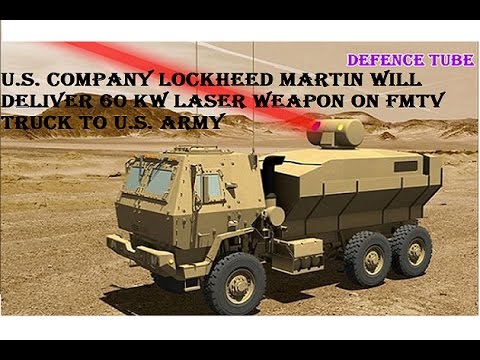

Laser weapons use high power lasers to damage or destroy adversary equipment, facilities, and personnel. The technology provides major advantages for military applications due to High precision and rapid on-target effect, precise and scalable effects, Avoidance of collateral damage caused by fragmenting ammunition, Low logistics overhead and minimum costs per firing.
Laser weapons have already been employed on warships and military trucks. In 2014, US Navy’s deployed 30-kilowatt Laser Weapon System (LaWS) on USS Ponce, the first laser weapon to have attained Initial Operating Capability (IOC) by virtue of being deployed in a combat theater. The system, offers military leaders precision accuracy at cost as low as a dollar per shot. ONR showed off a video in which the LaWS system — mounted on the ship’s super structure above the bridge — disabled a small Scan Eagle-sized UAV, detonated a rocket propelled grenade (RPG) and burned out the engine of a rigid hull inflatable boat (RHIB). Now they being planned to be deployed on Aircrafts and drones.
A truck-fired 50 kW laser weapon — an upgrade of the lumbering HEL-MTT — will be test fired in 2018. A 100 kW weapon on a more mobile vehicle — perhaps an 8×8 Stryker or tracked Bradley — will be test-fired in 2022. Currently the army is testing 5 to 10 kilowatt weapons on trucks and the Stryker. Current weapons are targeting quadcopters and mortars. Army is making progress to field viable DE weapon systems designed to counter rockets, artillery, and mortars (C-RAM) and address certain types of short-range air defense (SHORAD) threats. Moving up in power will mean being able to take out helicopters, low flying planes and possibly cruise missiles.
“Laser weapons are no longer a technological problem, It’s one of integration at the service level,” according to Lockheed executives. “The technologies now exist,” said Paul Shattuck, company director for Directed Energy Systems. “They can be packaged into a size, weight, power and thermal which can be fit onto relevant tactical platforms, whether it’s a ship, whether it’s a ground vehicle or whether it’s an airborne platform. “That doesn’t mean that giant city-melting lasers are on their way. Right now, the weapons are limited to the 15-30 KW scale; going much further requires figuring out how to deal with atmospheric interference, an issue which becomes more complicated with weapons mounted on airborne systems.”