

UAVs are Aircrafts that are piloted remotely by some person who is at a different place. These UAVs of various sizes and shapes can fly continuously for more than 24 hours and some of them can only fly for less than 30 minutes. Some UAVs have wings of several meters long, whereas some have wings of length less than 200 mm. These UAVs, which have wings of length less than 200 mm, are called Micro-Air Vehicles or MAVs.
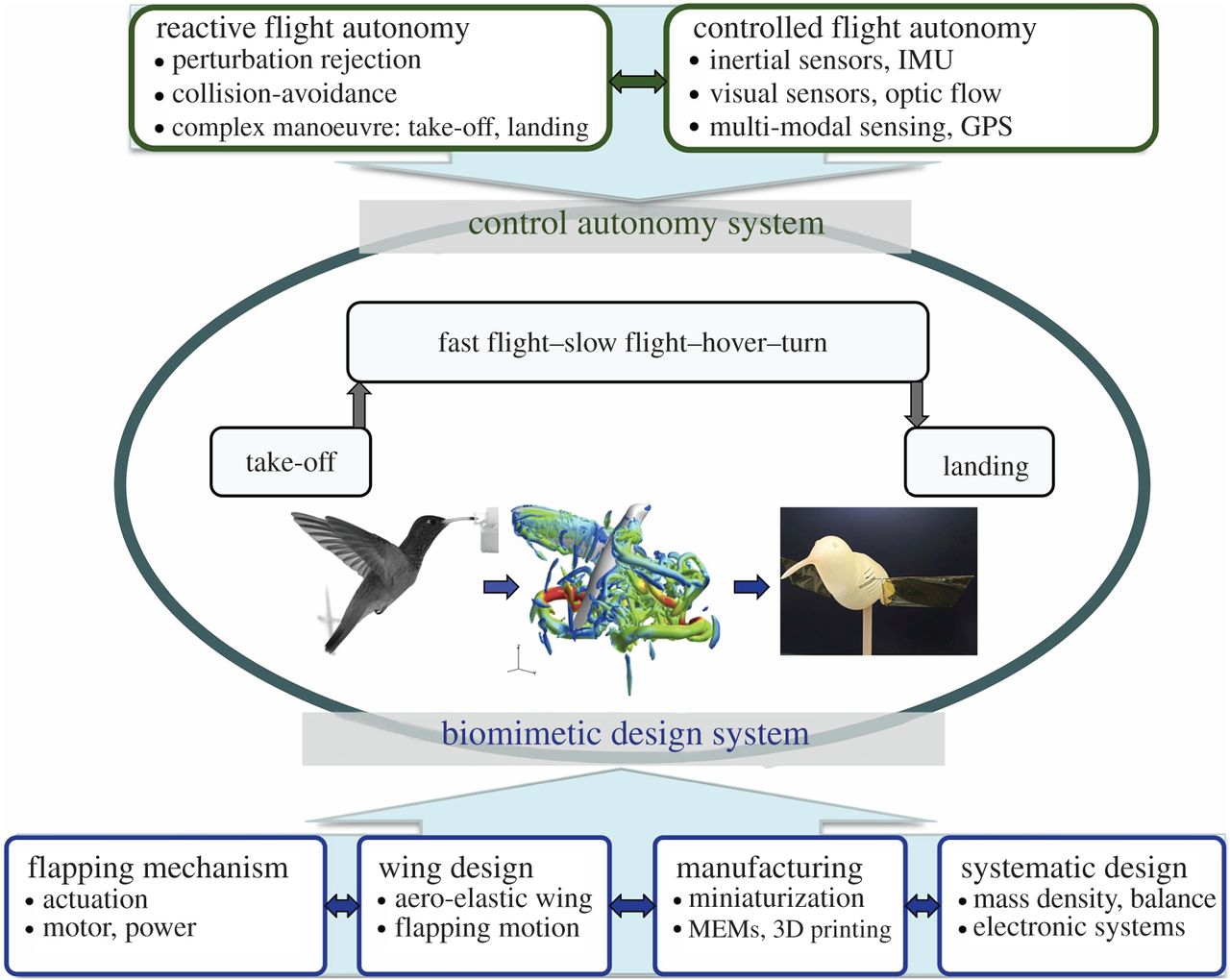
Modern MAVs can be as small as 5 cm the robot hummingbird MAV for a typical example. Compared to larger flying objects such as light planes, MAVs are also much lighter in weight, normally less than 1 kg, and their Reynolds numbers generally range between 100 and 10000 suggesting that they are more easily influenced by flying medium (i.e., air).
Despite their small sizes, MAVs can be classified into three main categories like other normal aircraft, namely the flapping wings, rotorcrafts, and fixed wings. Their flying times are mostly within hours, often powered by various types of batteries. The currently available MAVs are made for hobby purposes such as aerial contests and aerial photography, research purposes, or military applications. They can also be used for observing the traffic patterns in busy traffic lanes to reduce traffic congestion and surveying agricultural lands from the air to get live data on type of crops.
Militaries are now employing Micro, Mini & Nano UAVs into their operations. The Australian Army is planning to equip every combat platoon with PD-100 Black Hornet micro-unmanned aerial vehicles (UAVs) and each combat team with RQ-12 Wasp mini-UAVs, the service’s head of land capability has indicated. The PD-100 is already in use by the Norwegian, British and German Armed Forces. They provide situational awareness to a small group of soldiers by flying several stories above them for 10-20 minutes at a time before placed back into a pocket to recharge. These will be used to carry out tasks in urban environments, such as deliveries, surveillance, and search and rescue.