

More than thirty countries produce mines, and twenty countries export them. Iran has reportedly laid several thousand naval mines, North Korea’s 50,000, China 100,000 or so, and Russia estimated quarter-million. Since World War II, sea mines have damaged or sunk four times more U.S. Navy ships than all other means of attack combined, according to a Navy report on mine warfare.
Traditional navies as well as maritime terrorists can and have used mines and underwater improvised explosive devices (UWIEDs) to challenge military and commercial uses of the seas. With 95% of the world’s commerce moving by sea, the security of waters, coastlines and military personnel remains a key issue for navies. Sea mines and underwater explosives have become cheap to acquire and easy to deploy now pose a real threat to navies and commercial shipping by reducing freedom of movement in shallow waters and strategic choke points.
Mines can quickly wipe out, or seriously impair, the effectiveness of surface and submarine forces. Mines can also jeopardize the steady flow of seaborne materials, equipment, and fuels needed to sustain operations of land-based air and ground forces.
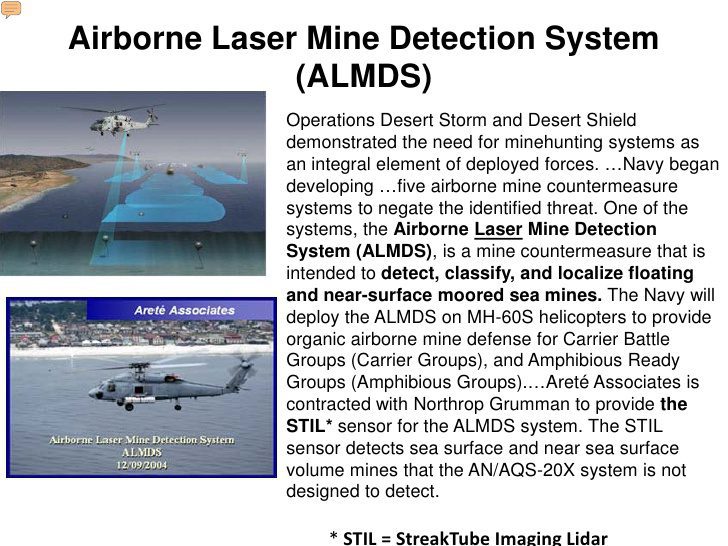
Navy requires Cheaper, Faster, More reliable and More capable mine countermeasure and neutralization systems. Airborne platforms can provide rapid search and detection of mines. Two airborne systems, the Airborne Laser Mine Detection System ( ALMDS) , and the Airborne Mine Neutralization System (AMNS), both will operate aboard the Navy’s MH-60S chopper to locate and take out sea mines from the air by means of powerful armor-piercing warheads. Both the AMNS, and ALMDS reached initial operational capability in November 2016.
ALMDS is a laser-based, high-area-coverage system designed to provide a wide-area reconnaissance and assessment of mine threats for Carrier and Expeditionary Strike Groups (CSG/ESG). It uses pulsed laser light and streak tube receivers to image the entire near-surface volume to detect, classify and localise near-surface, moored mines. AMNS-AF is designed to tackle the threat of modern mines. It has the ability to provide reacquisition, identification and neutralisation capability against bottom and moored sea mines. After identifying the threats during mine-hunting operations, AMNS-AF emits a warhead to explosively neutralise the target.
The Airborne Laser Mine Detection System, or ALMDS, which also works with MH-60S helicopters, uses Light Detection and Ranging (LIDAR) technologies to detect, classify and localize naval mines near-surface moored sea mines. “ALMDS is an optical system flown over the water, not towed through it. This enables the helicopter to conduct mine detection operations at greater speeds. This speed, combined with the laser’s wide swath, delivers a high area coverage rate,” explained Baribeau. Detecting mines more effectively and at greater distances with systems such as AMNS, naturally, could massively impact the US navy’s ability to respond to a wide range of threats.
The AN/ASQ‑235 Airborne Mine Neutralization System, or AMNS, receives surveillance information from a range of different navy systems before it reconfirms the target, deploys expendable destructors from MH-60S helicopters below the surface, and destroys the mine. Those vehicles are controlled from a console while they ID mines. Once they do, warheads are detonated to destroy the mines. The Airborne Mine Neutralisation System (AMNS) is designed to enable Carrier Strike Groups, Expeditionary Strike Groups and Amphibious attack missions to improve combat access while lowering risk to surface ships and sailors.
The Airborne Mine Neutralisation System (AMNS) is designed to enable Carrier Strike Groups, Expeditionary Strike Groups and Amphibious attack missions to improve combat access while lowering risk to surface ships and sailors. “The navy established a requirement for rapid neutralisation of bottom and moored sea mines to support operations in littoral zones (areas near the shore), confined straits, choke points and the amphibious objective area,” said Navy spokesman, Alan Baribeau. Mine Warfare program manager Captain Danielle George told that the Archer Fish is typically cued from a towed sonar. “It goes after bottom targets but not those that are found near the surface,” she said. This advancement will improve protection for submarines and surface ships while bringing new combat ability to maritime war operations, navy officials said.
In 2019, the US Navy’s Helicopter Sea Combat Squadron Two Eight (HSC 28) has used the latest airborne mine countermeasures (AMCM) systems in the BALTOPS exercise in the Baltic Sea. HSC 28 performed AMCM operations as part of the BALTOPS 2019 Mine Warfare Task Group. The Airborne Laser Mine Detection System (ALMDS) and Airborne Mine Neutralization System-Archerfish (AMNS-AF) were used in the Baltic Sea and the Naval Forces Europe area of operations for the first time. Aircrew operated the ALMDS and AMNS-AF systems from the MH-60S Sea Hawk helicopter. US Second Fleet commander vice-admiral Andrew Lewis said: “You should not underestimate the significance of this deployment for this squadron or naval aviation or the littoral combat ship platform.
ALMDS and AMNS-AF are part of the MCM Mission Package certified to be integrated on the Independence-variant littoral combat ships (LCSs). Assets that were part of BALTOPS 2019 Mine Warfare Task Group included more than 15 MCM ships, 15 unmanned undersea vehicles, five drone ships, and AMCM.