
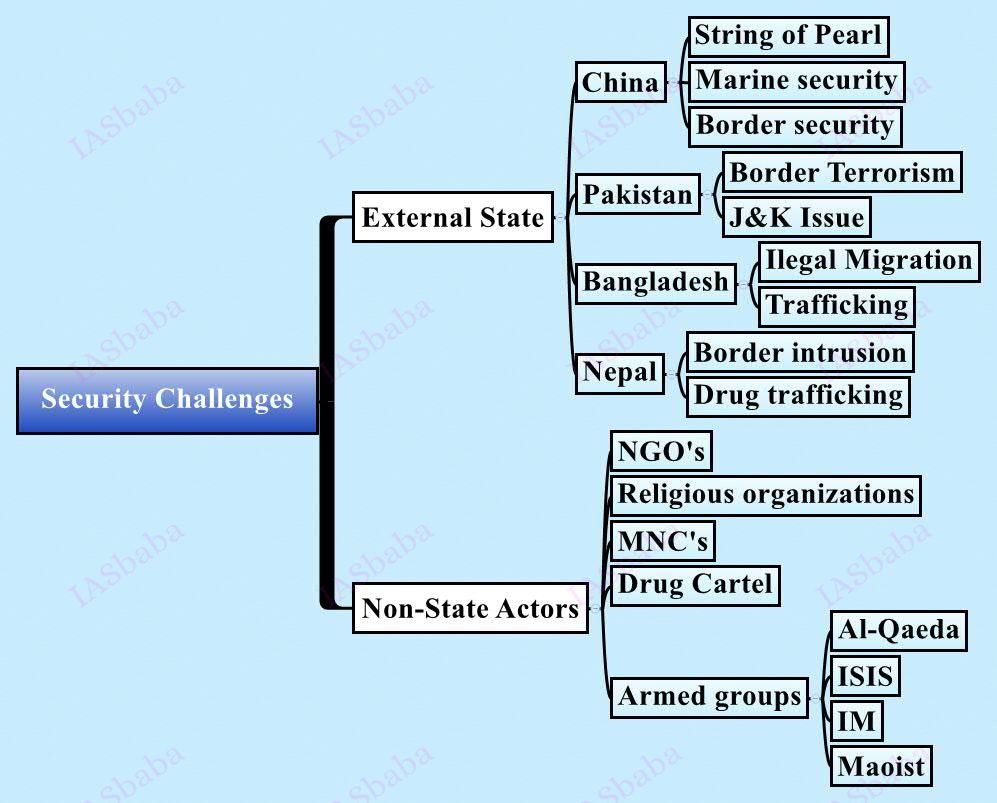

The long, porous and difficult borders have created the security challenges of illegal immigration, cross border terrorism, narcotics and arms smuggling, abetment of separatists and left -wing extremism and separatist movements aided by external powers. Pakistan policy of supporting cross border terrorism has led to constant border skirmishes along the line of actual control makes further accentuating the security challenges. Borders with Mayanmar and Nepal are also causing serious concern.
These terror operatives have travelled across borders from Afghanistan resulting in an enhanced vigil by the security forces to thwart infiltration and terror bids along the sensitive frontier in Jammu-Kashmir. Sources said that while infiltration bases and terror launch pads along the International Border (IB) in Jammu and Line of Control (LoC) in Kashmir are still intact, the latest concern of the security agencies are the well-trained terrorists from Afghanistan whose presence along the vulnerable infiltration spots along Pakistan border can be used to foment trouble in the newly-created Union Territory (UT) of Jammu-Kashmir and other locations in the hinterland. The BSF, they said, has also recently completed and exercise to fully “map and identify” vulnerable spots all along these two borders as part of a three-staged exercise carried out last year.
India faces major border management challenges having to manage over 15,000 km long borders with seven countries, sections of which are contested or not formally demarcated on the ground or constitute only an agreed line of control. Since most of Indian borders are man-made artificial boundaries and not based on natural features such as rivers and watersheds, they are very permeable and easy to cross. The task of border management become even more complicated due to geographical factors. There are mountains, swamps, rivers, deserts, forests, and variety of other geographical features which pose a challenge in front of security forces. Due to vulnerable borders, India has witnessed numerous cross-border terrorist attacks. During 2016, there were hundreds of instances of ceasefire violations and several security forces personnel and civilians were killed.
The challenges are equally formidable in maritime domain. India occupies a major strategic position in Southern Asia and has to gaurd its long coastline in Indian Ocean region that is 7,683 km long, and an Exclusive Economic Zone that is over two million square km in size, extended maritime zone, island territories, sea lanes of communication for its trade and energy flows and offshore oil installations.
“The challenge of long-standing boundary and territorial disputes, some of which are legacy issues, coupled with difficult terrain, extreme climatic conditions and porosity of borders, has rendered India’s Borders vulnerable to several external and internal security threats and made efficient and effective border management a foremost priority for the Indian Government,” writes parliamentary standing committee report.
To tackle these challenges, India has actively pursued the strategy of strengthening of border policing and guarding, creation of border infrastructure like roads, fencing and floodlight, Border Out Posts (BoPs), implementation of the Coastal Security Scheme to strengthen coastal security infrastructure, implementation of Border Area Development Programme and development of Integrated Check Posts (ICPs) on the land borders of the country including setting up of Land Ports Authority of India (LPAI).
The measures to check infiltration include boosting surveillance architecture and intelligence gathering, Minister of State for Defence Shripad Naik said in the Lok Sabha in March 2021. Naik said the ‘innovative’ deployment of troops, proactive use of surveillance and monitoring devices have enhanced the ability to detect and intercept terrorists attempting to infiltrate into India. ‘The Indian Army has adopted a robust counter infiltration strategy which has an appropriate mix of technology and human resource put together to check infiltration effectively,’ the minister said.
Security Requirements
Since the borders with six countries are having entirely different terrain and temperature profile the Indian Army needs for surveillance systems on these different border areas are also hugely varied. While the army would require the unmanned aerial vehicles for across the borders day-night monitoring in all the seasons, the ground level deployment of the night vision devices and other ground level intrusion detection systems are also very important.
Sources explained that what is badly needed in the region is surveillance equipment that can work at altitudes where temperatures dip to -40 degrees. While the situation along the LAC in Eastern Ladakh is peaceful and the number of intrusions by the Chinese is much less this year as compared to last year, surveillance is still an important requirement.The army has asked some industries to come to Nyoma and ahead of Partapur (Siachen brigade location) during November and December for the evaluation of their logistics and surveillance equipment. The army wants to check whether they can function in such weather.
Smuggling is one of the major challenges across the India Pakistan border. In a bid to counter the illicit activities across the border the government completed two pilot projects covering about 71 Kms on Indo-Pakistan Border and Indo-Bangladesh Border of Comprehensive Integrated Border Management System (CIBMS).
Terrorist infiltration from Pakistan has come down by a large extent in Jammu & Kashmir, though there is no let-up in attempts being made by the neighbouring country to push terrorists and weapons into India, the Army has said. According to official figures, 27 terrorists have infiltrated into India so far this year, as against 130 in 2019 and 129 in 2018. Sources in the defence and security establishment said higher deployment of troops, reshaping of the anti-infiltration grid, and use of technology have helped bring the number of successful infiltration attempts down in 2020.