

Psychological warfare involves the planned use of propaganda and other psychological operations to influence the opinions, emotions, motives, reasoning, attitudes, and behavior of opposition groups. Psychological warfare consists of attempts to make your enemy lose confidence, give up hope, or feel afraid, so that you can win. It is used to induce confessions or reinforce attitudes and behaviors favorable to the originator’s objectives, and are sometimes combined with black operations or false flag tactics. Psychological warfare (PSYWAR), or the basic aspects of modern psychological operations (PSYOP), have been known by many other names or terms, including MISO, Psy Ops, Political Warfare, “Hearts and Minds”, and propaganda. Psychological operations target foreign governments, organizations, groups and individuals. Civilians of foreign territories can also be targeted by technology and media so as to cause an effect in the government of their country.
Over the course of the past decade, social media platforms have evolved to play an ever-expanding role in the lives of users. In the United States, Americans get their news equally from social media and news sites, spend more than 11 hours per day on average “listening to, watching, reading, or generally interacting with media,” and express varying levels of trust in the reliability of information on social media. Further, social media companies increasingly offer users a wider array of services, pulling more of the average user’s time and attention to their platforms.
The reach and influence of the Social media has enhanced its importance to conduct psychological warfare for terrorists to Nation states. In 2016, Russia was accused of using thousands of covert human agents and robot computer programs to spread disinformation referencing the stolen campaign emails of Hillary Clinton, amplifying their effect. Russian influence operations on the social media have been reported to alter the course of events in the U.S. by manipulating public opinion.
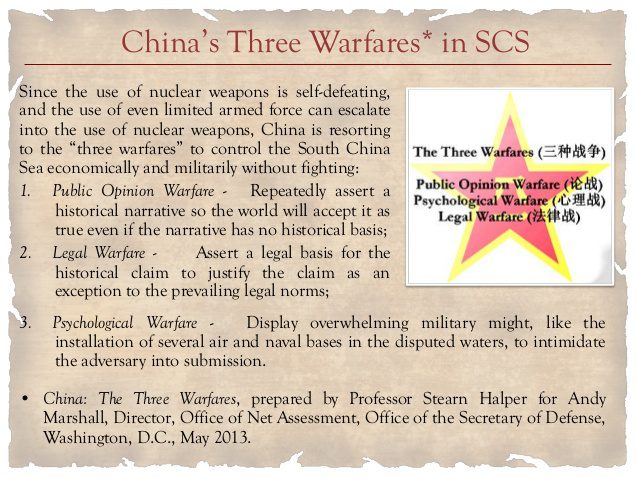
According to U.S. military analysts, attacking the enemy’s mind is an important element of the People’s Republic of China’s military strategy. This type of warfare is rooted in the Chinese Stratagems outlined by Sun Tzu in The Art of War and Thirty-Six Stratagems. Twenty-first-century warfare—where hearts, minds, and opinion are, perhaps, more important than kinetic force projection—is guided by a new and vital dimension, namely the belief that whose story wins may be more important than whose army wins. This is especially true if one avoids kinetic engagement altogether, wrote Stefan Halper, in China: The Three Warfares.