

Mobile communications systems have evolved through wireless technology innovation into 2G, 3G, and then 4G to keep pace with ever-increasing voice and data traffic. All mobile communication system generations have had a clear key application driver: 1G for analog voice, 2G for digital voice and text messaging, 3G for multimedia and Internet connectivity, and 4G for true mobile broadband.
Every generation of wireless technology brought many improvements including speed enabling many new applications. 1G was analog cellular. 2G technologies, such as CDMA, GSM, and TDMA, were the first generation of digital cellular technologies. 3G technologies, such as EVDO, HSPA, and UMTS, brought speeds from 200kbps to a few megabits per second. 4G technologies, such as WiMAX and LTE, have scaled up to hundreds of megabits and even gigabit-level speeds.
5G, short for 5th generation mobile networking or 5th generation wireless systems is the latest iteration of cellular technology that will provide seamless coverage, high data rate, low latency, and highly reliable communications. Part of the 5G spec allows 5G phones to combine 5G and 4G channels invisibly and seamlessly to the user. Initially, all 5G networks used 4G to establish their initial connections, something called “non-standalone.” We’re starting to move away from that now into “standalone” networks.
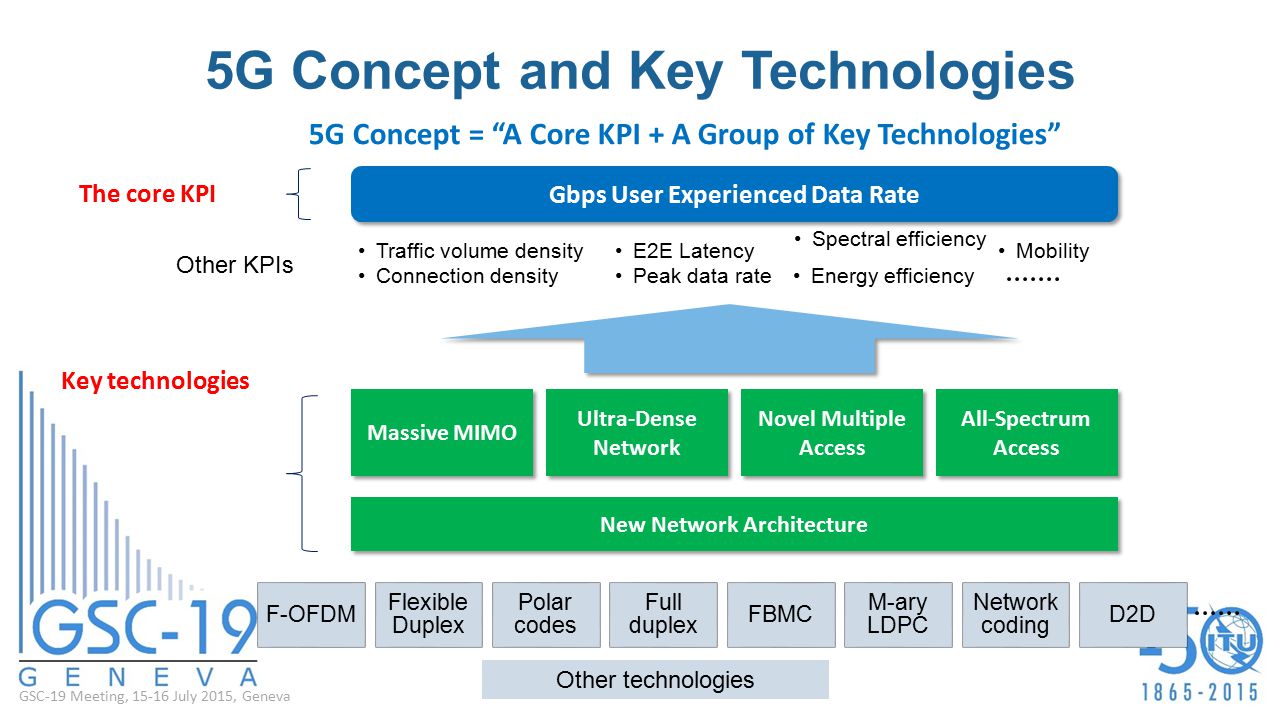
A fully evolved 5G system needs to support diverse application areas such as enhanced mobile broadband (eMBB), massive Internet of things (MIoT), and mission-critical communications (MCC) . All these use cases have distinct and partly contradictory requirements in terms of their key performance indicators, making the system concept design, as a whole, extremely complex. In most of the cases, not all of the requirements need to be simultaneously met. Thus, advanced 5G infrastructures move away from a “one architecture fits all” nature towards a “multiple architectures adapted to each service” concept
It will increase energy efficiency, spectrum efficiency, network efficiency and act as an information duct to connect billions of Internet of Things (IoT) devices. The upcoming universal specification will support a million connected devices per square kilometer; 1-millisecond latency, or the amount of time a packet of data takes to get from one point to another; higher energy and spectral efficiency; and a peak data download rate of up to 20 gigabits per second.
5G is hitting the mainstream fast: According to a GSA report, around 70 countries had 5G networks as of June 2022, up from just 38 in mid-2020. Approximately 15 more have had 5G mobile technology deployed in part. It is expected that 5G will reach 1 billion users in 2022 after just in 3.5 years in use, compared with 4 years for 4G and 12 years for 3G. The total number of deployments increased dramatically during the same time period with 85,602 deployments on November 30, 2021 compared to 17,428 on November 30, 2020, highlighting the degree to which 5G networks scaled during the year.
Global 5G mobile subscriptions were estimated to be more than 660 million by the end 2021, with China accounting for almost 80% of the total, according to Ericsson Mobility report. This growth is being driven by high levels of consumer demand in North America and North East Asia, particularly China; early deployment and commitment to 5G networks; and falling smartphone prices.
5G subscriptions in North East Asia far outstripped any other region in the world, with subscriptions totaling 517 million. China made up 460 million of these or 70% of the global total. By contrast, North America totaled 80 million subscriptions and Europe 33 million.
South Korea is the country that deployed the first 5G network and is expected to stay in the lead as far as penetration of the technology goes, By 2025, almost 60 percent of mobile subscriptions in South Korea are expected to be for 5G networks. A launch in India is expected in 2023 and an auction for 5G bandwidth frequencies kicked off this week.
Speedtest Intelligence data from Q3 2021 shows a wide range of median 5G speeds among global capitals. Seoul, South Korea and Oslo, Norway were in the lead with 530.83 Mbps and 513.08 Mbps, respectively; Abu Dhabi, United Arab Emirates; Riyadh, Saudi Arabia and Doha Qatar followed. Stockholm, Sweden and Oslo, Norway had some of the the fastest median upload speeds over 5G at 56.26 Mbps and 49.95 Mbps, respectively, while Cape Town had the slowest at 14.53 Mbps.
“Groundbreaking innovations will drive 5G technologies to meet the unprecedented speeds, near-wireline latencies, ubiquitous connectivity with uniform QoE, and the ability to connect massive amounts of devices with each other, all working in unison to provide the user with an immersive experience, even while the user is on the move,” says Samsung 5G vision.