
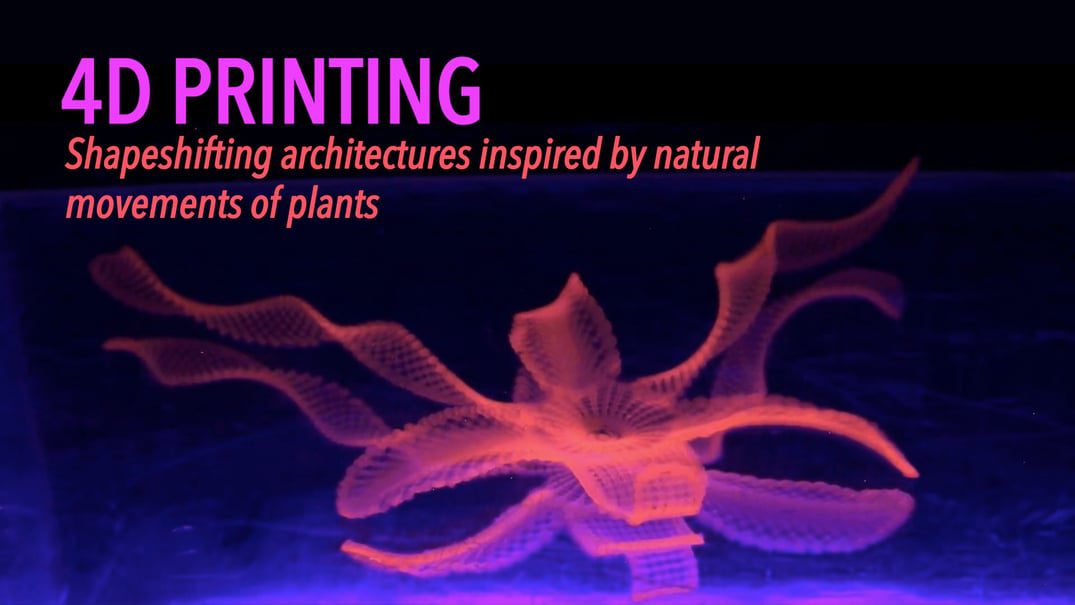

3D printing or additive manufacturing is ongoing revolution in manufacturing with its potential to fabricate any complex object and is being utilized from printing small components to full drones on Naval vessels, printing replacement parts for fighter aircrafts to printing ammunitions, textiles, metals, human organs, clothing, buildings and even food. Now 3D printing is evolving into 4D printing, which is the ability to 3D-print objects that can change their properties, shape or appearance over time [the fourth dimension], or in response to some condition.
The potential applications for 4-D printed objects reaches across scientific disciplines and uses. Window shades that can change to allow more or less light in during the day. Furniture that is packaged flat, but self assembles in your home after purchase; Shoes/clothes/gear that adapt to the user’s performance and the changing environment, thus offering enhanced performance, fit, or style.
Zhen Ding at the Singapore University of Technology and Design and his colleagues have now developed a way to rapidly print rigid 4D objects with a commercial 3D printer and a heat source. They created a variety of objects, including a delicate flower that closes its petals, a flat star shape that morphs into a dome, and lattices that contract and elongate. The structures were made from flat 3D-printed strips that were then heated to make them curve.
MIT is releasing free software and a recipe for its magnetic ink so that other scientists around the world can use the technology and print their own shape-shifting materials, Zhao said. “With these three components they can design their own untethered, fast-transforming soft robots,” he said. “We hope this method can find very important applications in the fields of soft robotics [and] materials.”
Researchers like Lipson think 4-D printing could have a big impact on robotics: Printers could print robots that build printers that build robots. “Material objects could be recycled not by saving some of the materials such as plastic to be melted down and reused, but by commanding the object to decompose into programmable particles or components that then can be reused to form new objects and perform new functions. The long-term potential of PM/4DP thus could be a more environmentally sustainable world in which fewer resources are necessary to provide products and services to a growing world population and rapidly expanding global middle class.”
” Now a new disruptive technology is on the horizon that may take 3D printing to an entirely new level of capability with profound implications for society, the economy, and the global operating environment of government, business, and the public,” note Thomas A. Campbell.