

Radar, electromagnetic sensor used for detecting, locating, tracking, and recognizing objects of various kinds at considerable distances. It operates by transmitting electromagnetic energy toward objects, commonly referred to as targets, and observing the echoes returned from them. Energy is emitted in various frequencies and wavelengths from large wavelength radio waves to shorter wavelength gamma rays.

Radar is an “active” sensing device in that it has its own source of illumination (a transmitter) for locating targets. It typically operates in the microwave region of the electromagnetic spectrum—measured in hertz (cycles per second), at frequencies extending from about 400 megahertz (MHz) to 40 gigahertz (GHz), highlighted in yellow. It has, however, been used at lower frequencies for long-range applications (frequencies as low as several megahertz, which is the HF [high-frequency], or shortwave, band) and at optical and infrared frequencies (those of laser radar, or lidar). The targets may be aircraft, ships, spacecraft, automotive vehicles, and astronomical bodies, or even birds, insects, and rain. Besides determining the presence, location, and velocity of such objects, radar can sometimes obtain their size and shape as well.
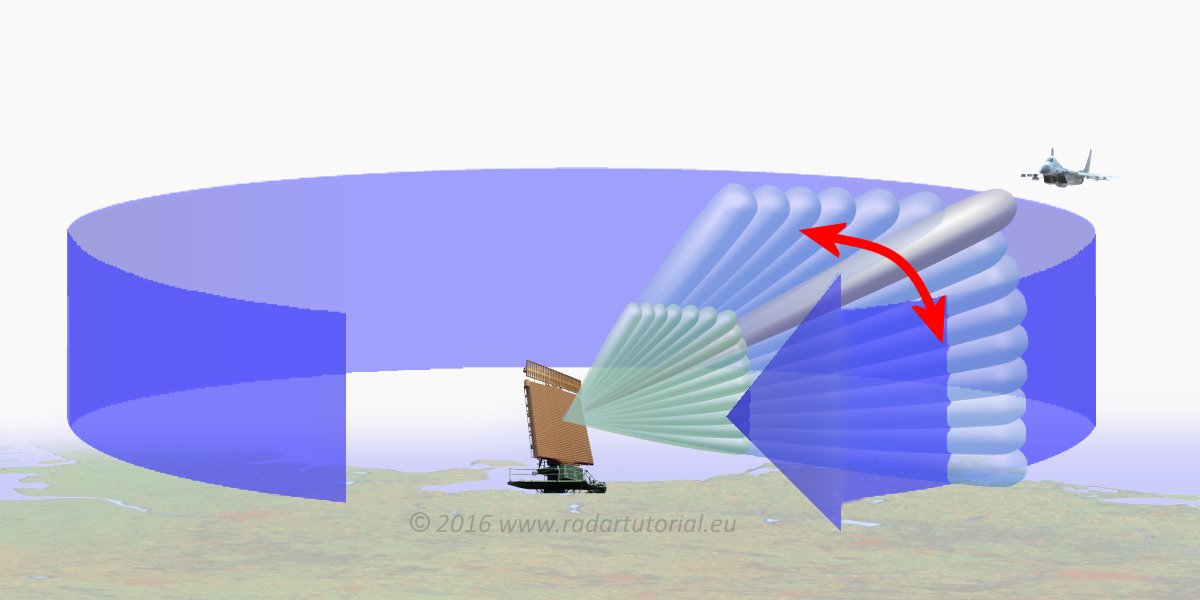
Conventonal radars were 2D radars that were confined to 2 dimensions providing information of range and bearing while 3D radar displays information of elevation, bearing, and range. The information provided by 3D radar has long been required, particularly for air defence and interception. Interceptors must be told the altitude to climb to before making an intercept. Before the advent of single unit 3D radars, this was achieved with separate search radars (giving range and azimuth) and separate height finding radars that could examine a target to determine altitude. These had little search capability, so were directed to a particular azimuth first found by the primary search radar.
Long range 3D radar has gained popularity in recent years, owing to its growing applicability in weather monitoring applications as it helps in accurate prediction of natural calamities, such as floods, earthquakes, cyclones, and hurricanes. Moreover, 3D radar is largely being adopted by the air force or defense for monitoring and surveillance of weather and air defense