
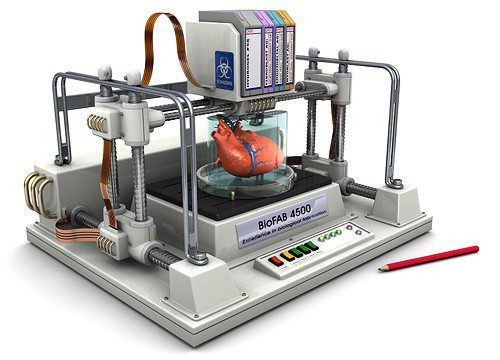

In the UK, there are some 7,000 people on the list who are in dire need of organ transplants and In the US, the number awaiting transplant is around 120,000, with 20 dying each day for want of an organ. There is a large and growing need for an alternative to the organ transplant waiting list.
To alleviate this problem, Scientists have turn to lab grown organs. Further growing artificial organs is further enabled through 3D printing or bioprinting which promises to bring the speed, flexibility, and customization.
“3D Bioprinting” or “bioprinting” is a form of additive manufacturing that uses cells and biomaterials instead of traditional metals and plastics to create 3D constructs that are functional 3D tissues. These biomaterials are called bioinks, and they mimic the composition of our tissues. Bioprinting can be applied to a variety of areas including but not limited to regenerative medicine, drug discovery and development, and 3D cell culture.
Current organ transplant patients have to take immunosuppressant drugs all their life to prevent the body rejecting the new addition whereas using human cells, specifically those from the same patient, would reduce any possibility of rejection.
For pharmaceutical development, 3D bioprinting offers a means of testing drugs faster, at a lower cost, and with better biological relevance to humans than animal testing. In the biomedical devices field, 3D bioprinting has enabled new developments such as sugar stents to help surgeons join veins with fewer complications, and systems for improved drug delivery, among others.
3D printing in future could let physicians print structures made of human cells — from tiny structures like ‘organs on a chip’, to huge ones like whole replacement organs. Bioprinted organs made from an individuals’ own tissue won’t be rejected by their body, will last far longer, won’t need anti-rejection meds, and can be custom made to the individual’s exact measurements — whether they’re a four year old or a NFL linebacker.
The first human corneas to come out of a low-cost 3D printer were created by a team of researchers at Newcastle University in the UK. However, not all human organs are created equally — or can be created by bioprinting, for that matter. Flat tissues, like skin, and hollow ones, like the stomach or bladder, are relatively easy to print, whereas complex solid organs — the heart, liver, or pancreas — would be far harder to recreate with printing due to the rich blood supply they need.
The common challenge shared by all tissue engineers is what is known as vascularization. Scientists have struggled to create the intricate networks of tiny blood vessels that carry nutrients and oxygen deep into organs and carry waste products out. The bigger an organ is, the more blood supply it needs to bring organs and nutrients to the tissue. Large organs need a complex web of interconnected, different-sized arteries, capillaries, and veins. The walls of the vessels need to be strong enough to withstand the normal flow of blood through them without causing clots, and need to be made of specific layers. For now, it’s too much complexity for 3D bioprinters to manage.
That’s why most demonstrations thus far have been of organelles just an inch or two across or hollow structures like throats or bladders. But latest research has even surmounted this last difficulty paving the way of commercializing 3d printing of human organs.
Recently, a team of American researchers led by scientists at Rice University in Texas have created a 3D bioprinter that can print vessels less than a third of a millimeter wide in biocompatible hydrogels. In a paper in Science they describe how they used the bioprinter to create a model of the human lung that can effectively oxygenate human blood. “I think within ten years we won’t see any more heart transplants, except for people with congenital heart damage, where only a new heart will do,” Stephen Westaby, from the John Radcliffe Hospital in Oxford, told The Telegraph.
Now, Researchers at Rensselaer Polytechnic Institute have developed a way to 3D print living skin, complete with blood vessels. The advancement, published online in Tissue Engineering Part A May 2019 , is a significant step toward creating grafts that are more like the skin our bodies produce naturally.
While researchers are working on how to print full-size organs, the tiniest bioprinted structures are already helping researchers. Bioprinting can also be used to make ‘organs on a chip’ — tiny samples of tissue that mimic the functions and structures of their full-grown counterparts. These mini organs allow pharmaceutical companies to test drugs on versions of human tissues, and assess their effectiveness or toxicity instead of using unreliable and ethically difficult animal models.
One day, organs on a chip could be made using individuals’ own cells to test potential therapies. Rather than using the same standard treatments for every patient, by taking some cells, culturing them and printing them onto the chip, physicians can have a unique view into how their patient will react to a particular drug without having to start them on a whole course of it.
“These miniature human organs we can use for drug discovery, direct toxicity testing, and personalised medicine, BCS modelling and personalised medicine. We’ve taken the same strategy, and by using the same printers, we can print miniature structures that replicate the normal human response,” Dr Anthony Atala, director of the Wake Forest Institute for Regenerative Medicine says.
While HP’s printers are more associated with offices rather than labs, HP also sells printers to the life sciences industry with its D300 BioPrinter line which prints drugs instead of documents. The machines are typically used in small to medium pharmaceutical companies in secondary drug discovery, where compounds thought to be effective against a particular disease are tested to see if they have any affect against the condition, and if so, at what dose.
The bioprinters are also being used elsewhere in the fight against coronavirus. HP has donated four of the D300e BioPrinters to four research facilities working on COVID-19: the Spanish National Research Council, the Monoclonal Antibody Discovery Laboratory at Fondazione Toscana Life Sciences in Italy, the US Center for Nuclear Receptors and Cell Signaling (CNRCS) at University of Houston, and France’s Grenoble Alpes University Hospital. Between them, the facilities are using the machines for research into the fundamental biology of COVID-19, monoclonal antibodies and other potential therapeutic candidates, and work on immunisation.
The success of bioprinting could become the key enabler that personalized medicine, tissue engineering, and regenerative medicine need to become a part of medical arsenals. Breakthroughs in bioprinting will enable faster and more efficient patient care and recovery. Biofabrication could be used to reshape the foundations of drug development, medicine, cosmetics, organ transplantation, and many other fields. It will transform the way doctors repair damaged ligaments, recreate tissues, and even reproduce the layers of the skin. The future of healthcare is likely to be 3D printed.