
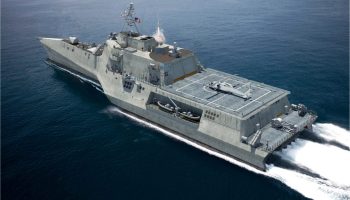

The US Navy’s “Littoral Combat Ship” program developed a new generation of affordable surface combatants that could operate in dangerous shallow and near-shore environments, while remaining affordable and capable throughout their lifetimes. LCS was designed for countering Asymmetric and A2/AD threats.
However according to experts expressed doubt about its power projection capability. In October 2015, Russian warships belonging to the Russian Navy’s Caspian Sea Strike Group launched 26 cruise missiles against Islamic State targets located in Syria.”To put things in perspective, the two variants of the U.S. Littoral Combat Ship, Freedom and Independence, are substantially larger at roughly 2,900 tons and 3,100 tons respectively—but they do not possess any cruise missile or similar power projection capability,” wrote Garrett I. Campbell Federal Executive Fellow, Brookings Institution. Therefore LCS do not currently possess the power-projection capabilities recently demonstrated by Russia’s Caspian Sea fleet.
The U.S. Navy is looking for inputs from industry on a new multimission guided-missile frigate adapted from existing ship designs, a major departure from its modular littoral combat ship, according to a request for information released Monday. US Navy’s future Guided Missile Frigate (FFG(X)) shall provide Combatant and Fleet Commanders a uniquely suitable asset to achieve select sea control objectives and perform maritime security operations while facilitating access in all domains in support of strike group and aggregated fleet operations.
Unlike the LCS, the frigates should be able to integrate into carrier strike groups and large surface combatant led surface action groups supplementing the fleet’s undersea and surface warfare capabilities. It should also be able to defend itself during independent operations in a contested environment extend the fleet tactical grid, and host and control unmanned systems.
The navy is also expecting the frigate to assume some of the duties of large surface combatants like the over-tasked Arleigh Burke-class destroyers during “operations other than war”. These operations include presence missions, security cooperation activities and humanitarian assistance and disaster relief (HA/DR) efforts among other.
The U.S. Navy would like for the ship to be able to Kill surface ships over the horizon, Detect enemy submarines, defend convoy ships, Employ active and passive electronic warfare systems and Defend against swarming small boat attacks.
Major warfare systems that the U.S. Navy would like to have on the frigate include an Aegis-derivative COMBATSS-21 combat management system that uses a common source library, a C4I suite, an Enterprise Air Surveillance Radar (EASR), Mk53 Decoy Launching System (Nulka), Four canister launched over-the-horizon weapons, SeaRAM Mk15 Mod 31 in addition to a UAV and an MH-60R helicopter.
What the navy is particularly interested in is the ship’s vertical launch cell potential to support Evolved Sea Sparrow Missile Block 2 and/or Standard Missile-2 Active missiles. The navy wants a description of launcher type and cell quantities the proposed design could accommodate.
Other capabilities in “tier two” include various sonar equipment such as variable-depth and towed-array sonar, Cooperative Engagement Capability to be able to share target data with other ships and aircraft in the fleet, rigid-hull inflatable boats, Next Generation Surface Search Radar, and a MK 110 57mm gun and related systems.
The U.S. Navy wants the frigate to have a 25 year service life and a grade A shock hardening for propulsion, critical systems, and combat system elements to retain full air defense and propulsion capabilities.