
Strategy, Policy & Governance examines how states, institutions, and power centers define objectives, design policies, and govern complex security and technology ecosystems. This magazine focuses on the strategic decision-making layer—where doctrine, policy, regulation, and long-term planning translate national intent into coordinated action across military, technological, economic, and societal domains.
IDST Intelligence Briefings
Why This Magazine Exists
Strategy, Policy & Governance examines how states, institutions, and power centers define objectives, design policies, and govern complex security and technology ecosystems. This magazine focuses on the strategic decision-making layer—where doctrine, policy, regulation, and long-term planning translate national intent into coordinated action across military, technological, economic, and societal domains.
What We Track
This magazine examines the strategic, policy, and governance dimensions that shape national security, defense modernization, technological competition, and institutional resilience. It analyzes how governments, militaries, industries, and international organizations formulate strategy, manage risk, govern emerging technologies, and adapt to an increasingly complex security environment.
Coverage spans defense policy and doctrine, strategic planning, civil–military relations, technology governance, regulatory frameworks, innovation ecosystems, resilience building, and long-term preparedness—providing the context needed to understand not only how security challenges emerge, but how nations organize to address them.
Latest Analysis & Intelligence
-
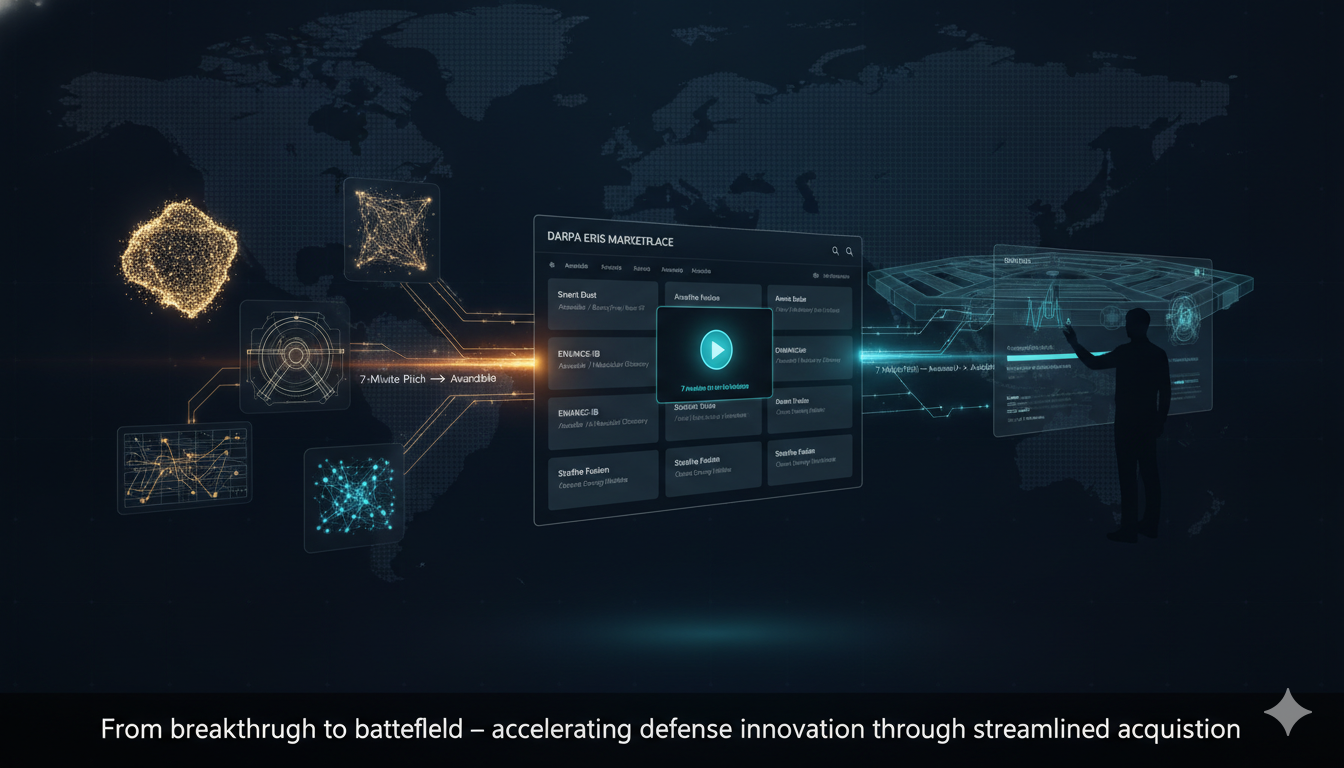
DARPA ERIS Marketplace: Reinventing Defense Acquisition for the Age of Strategic Competition
Introduction: Why Defense Innovation Matters Now The character of technological competition is changing faster than traditional defense acquisition systems can respond. Artificial intelligence, autonomous systems, biotechnology, quantum technologies, advanced semiconductors, and space capabilities are evolving on commercial innovation cycles measured in months rather than decades. At the same time, geopolitical competition among major powers has…
-

The Flat Lens Revolution: How Meta-Optics Are Reshaping Imaging, Sensing, and Photonics in 2026
Introduction: Why Meta-Optics Matter Now For centuries, optical systems have relied on curved glass lenses to manipulate light. From microscopes and cameras to telescopes and military sensors, advances in optics were largely achieved by adding more lens elements, improving glass quality, and refining manufacturing precision. However, as industries demand increasingly compact, lightweight, and intelligent devices,…
-

2D Transistors in 2026: The Post-Silicon Revolution Has Begun
Introduction: Why 2D Transistors Matter Now The global semiconductor industry is entering one of the most consequential technological transitions since the invention of the integrated circuit. For more than fifty years, silicon transistors have served as the foundation of modern computing, enabling the steady progression of Moore’s Law and fueling advances across consumer electronics, cloud…
-

Modeling & Simulation in 2026—The Digital Backbone of Multi-Domain Warfare
Introduction For centuries, military superiority depended upon larger armies, better weapons, and superior logistics. During the Information Age, it increasingly depended upon sensors, networks, and precision-guided systems. In the emerging era of Artificial Intelligence and Multi-Domain Operations, however, a new strategic capability has become indispensable: the ability to create an accurate digital representation of reality,…
-

Green Factories 2026: How Plant Synthetic Biology is Revolutionizing Biomanufacturing, Strategic Supply Chains, and the Global Bioeconomy
For much of modern biotechnology, microorganisms such as bacteria and yeast, along with mammalian cell cultures, have served as the foundation of industrial biomanufacturing. They produce vaccines, enzymes, pharmaceuticals, specialty chemicals, and biofuels that support trillion-dollar industries. However, these systems require energy-intensive bioreactors, sterile infrastructure, sophisticated logistics, and expensive downstream processing. As global demand for…
-

Agentic AI in Cybersecurity: The Rise of Autonomous Defense
Introduction: From AI-Assisted Security to Autonomous Cyber Defense For nearly three decades, cybersecurity has largely been a human-centered discipline. Security analysts collected logs, correlated alerts, investigated incidents, and manually orchestrated defensive actions while automation handled repetitive tasks through predefined rules. Artificial intelligence improved detection by identifying anomalies and prioritizing alerts, but the human analyst remained…
-

Revolutionizing Protein Manufacturing: Cell-Free Protein Synthesis in the Era of AI, RNA Origami, and Biosecurity
Introduction: From Living Factories to Programmable Biomanufacturing For more than half a century, the biotechnology industry has relied on a simple principle: if a protein is needed, engineer a living cell to produce it. Whether using Escherichia coli, yeast, insect cells, or mammalian Chinese Hamster Ovary (CHO) cells, proteins have traditionally been manufactured inside biological…
STRATEGIC SUB-MAGAZINES
The Strategy, Policy & Governance magazine connects multiple strategic sub-domains that examine power, risk, and coordination from different angles.
Geopolitics, Strategy & Technological Rivalries
Focuses on interstate competition, alliances, power balances, and long-term rivalry dynamics shaped by technology and economics.
Explore the Geopolitics, Strategy & Technological Rivalries Sub-Magazine →
Global Risks & Future Threats
Examines systemic risks, emerging threat vectors, gray-zone challenges, and future conflict drivers beyond conventional war.
Explore the Global Risks & Future Threats Sub-Magazine →
Technology & Systems Management
Analyzes how complex defense and security systems are governed, integrated, regulated, and sustained across institutions..
Explore the Technology & Systems Management Sub-Magazine →
Related Domains & Cross-Cutting Themes
Strategy, Policy & Governance does not operate in isolation. Coverage within this magazine frequently intersects with Defense & Military Systems, Critical & Emerging Technologies, Industry, Markets & Supply Chains, Space Technology, Defense & Exploration Readers interested in deeper technical, industrial, or geopolitical dimensions are encouraged to explore related magazines across the IDST intelligence network.
Explore the Defense and Military Systems Magazine →
Explore the Critical & Emerging Technologies Magazine →
Explore the Industry, Markets & Supply Chains Magazine →
Explore the Space Technology, Defense & Exploration Magazine →